
The performance case — throughput, ROI, one vendor for the whole floor — was settled before any of this changed. American ownership just added a reason you didn’t know you were getting.
US Federal Communications Commission added foreign-manufactured advanced robotic devices to its national-security Covered List.
Prime Robotics: American-owned. Unaffected. New orders fulfilled with US-manufactured, FCC-compliant robots.
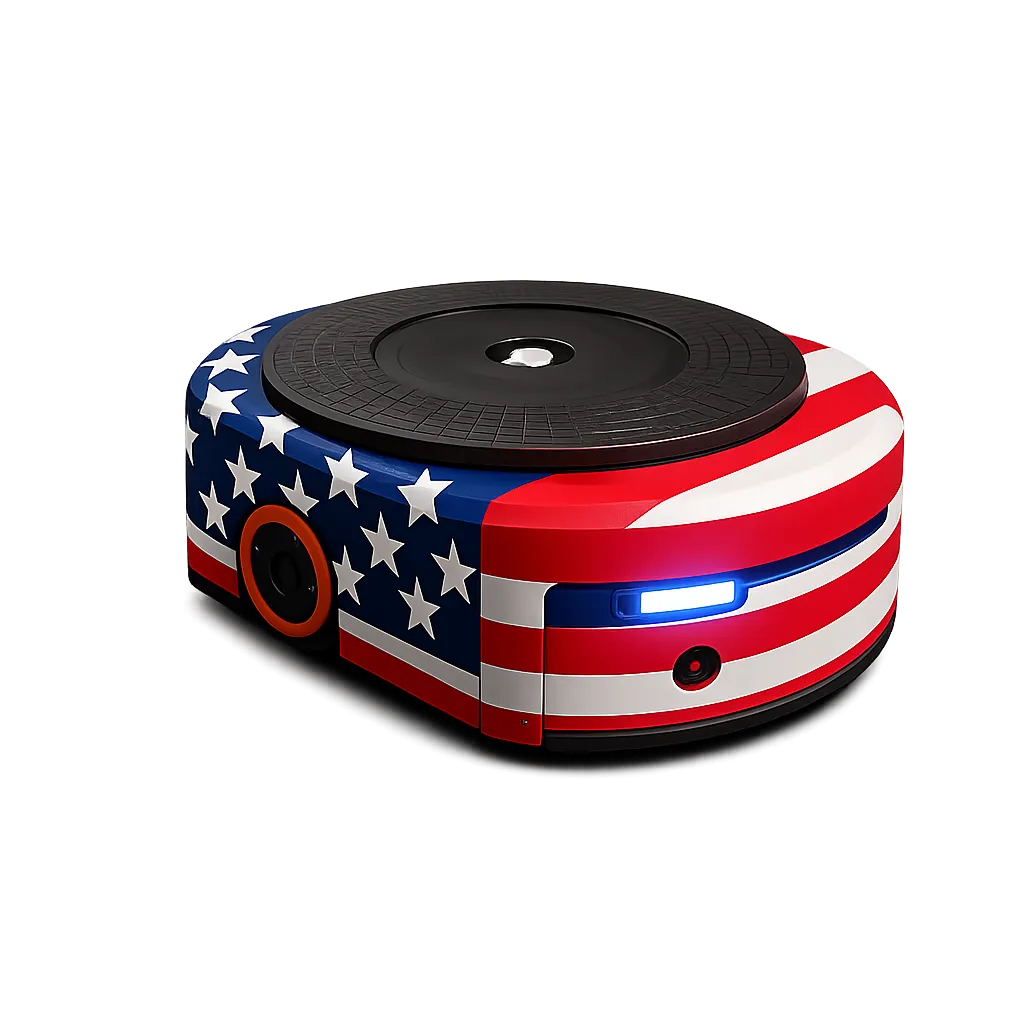
Every robot Prime deploys is backed by an American-owned company with American engineers, American support teams, and no foreign ownership exposure. When regulators move — and they are moving — Prime’s customers don’t have a decision to make.
Buyers who chose Prime before the regulatory picture changed did so because the system outperformed the alternatives on throughput, support, and total cost of ownership. That decision holds. The geopolitical argument is an additional reason — not the primary one.
Here is what the performance case looks like in production:
Labor ratio, in production
One station and one arm now does the work of nine people — running right now at a national 3PL. Not a projection.
Typical ROI payback
A pattern across 12 live deployments. One vendor who owns the whole floor removes the integration cost that extends every competitor’s payback period.
Vendor for robots, software, and stations
PrimeOS orchestrates every device on your floor — Prime hardware and third-party alike. No integration gap. No finger-pointing when something doesn’t work.
The engineering team that built PrimeOS is the team that fixes it. Denver, Mountain Time. When your busiest shift runs into a problem, resolution happens during your business hours — not after an overseas team wakes up and works its way through a ticketing system.
That was always the practical case for Prime. Here is the one that has gotten more important.
PrimeOS — US-engineered
Every workflow, every device integration, every update. The team that built the software is the team that fixes it — in the same time zone as your operation.
Native English. Mountain Time.
No translation layer between your ops team and the engineers resolving your issue. Same business hours. Direct communication.
Decisions made in Denver
Pricing, roadmap, deployment priorities — decided by an American leadership team with no foreign approval chain and no foreign government obligation.
China’s National Intelligence Law, enacted in 2017, legally requires every Chinese company and every Chinese citizen to support, assist, and cooperate with Chinese state intelligence and military operations — on demand, without the right to refuse. This is not a geopolitical theory or a trade-war talking point. It is codified statute.
A Chinese robotics vendor deploying networked, sensor-equipped autonomous systems in US facilities is, by legal obligation, an extension of the Chinese state. Not because of intent. Because of law. The vendor does not have the option to say no.
“When Chinese engineers built your warehouse automation system, Chinese law followed it through the door.”
This matters specifically for warehouse automation because modern AMR systems are not passive equipment. They map your facility layout in real time, collect operational data continuously, handle inventory information, and communicate over network connections. The data profile of a warehouse AMR fleet is meaningful intelligence — and under China’s National Intelligence Law, a Chinese vendor is legally required to provide access to it if the Chinese state demands it.
“All organizations and citizens shall, in accordance with the law, support, assist, and cooperate with national intelligence work.”
“The state shall protect individuals and organizations that support, assist, and cooperate with national intelligence work.”
National Intelligence Law of the People’s Republic of China, enacted June 27, 2017. No Chinese company has the legal right to refuse compliance.
The US government has been systematically working through categories of Chinese-manufactured technology embedded in American infrastructure. Each category began with a first formal step. Restrictions tightened from there. Warehouse robotics is next in the sequence.
Hikvision — one of the world’s largest surveillance camera manufacturers — was placed on the US Entity List. HIK Robotics, its warehouse AMR division, argued it was a separate business unit and therefore outside the ban. The US government rejected that argument. HIK Robotics was forced to exit the US market. US warehouse operators running HIK systems were left without a compliant vendor mid-operation. Prime came in — first with loaner robots to get one customer independent within six weeks, then with a permanent fleet running hybrid SLAM navigation. The customer ended up with a more capable system than what they had. But only because they moved fast.
Equipment stripped from US carrier networks across the country. The concern was not product quality — Huawei’s hardware was technically competitive. The concern was that China’s National Intelligence Law required Huawei to provide access, backdoors, and cooperation to Chinese intelligence on demand. Carriers who had built on Huawei infrastructure faced expensive, disruptive replacements. The US government acted before a crisis materialized, not after. The legal reasoning is identical to the warehouse AMR situation.
DJI drones banned from federal use and flagged as a national security concern. The same legal structure — autonomous systems, real-time sensors, data collection, network connectivity, Chinese ownership — applied to aerial hardware. Federal agencies did not wait to find out what data was collected or transmitted. The pattern is the same: autonomous, networked, sensor-equipped equipment with Chinese ownership and therefore Chinese legal obligations.
The FBI and CISA flagged Chinese-manufactured port cranes — specifically ZPMC cranes — for embedded cellular radios with no identifiable operational purpose. Autonomous, networked equipment on critical US logistics infrastructure. The concern was data collection and potential remote access. Congress acted. The logical extension to warehouse automation is direct: autonomous systems, network-connected, operating on US logistics infrastructure.
Autonomous mobile robots are networked, sensor-equipped systems that map your facility layout, handle your inventory data, and take operational instructions over connected software. The logic that applied to port cranes — and to Huawei, and to DJI, and to HIK Robotics — applies here. The FCC’s July 2026 ruling is the first formal step for this category. It will not be the last.
In July 2026, the FCC added foreign-manufactured advanced robotic devices — explicitly including autonomous mobile robots — to its national-security Covered List. New models from foreign-owned vendors can no longer receive the equipment authorization required to be imported, marketed, or sold in the United States.
This is the first formal regulatory step for warehouse robotics specifically. If the precedents above are any indication, clients should not assume this is where the regulation stops. In each prior category, the first formal step was followed by tightening restrictions — procurement bans, operational requirements, replacement mandates. The pace of that progression accelerated with each new category.
As of July 2026, autonomous mobile robots manufactured by foreign-owned entities are explicitly covered. New models cannot receive the FCC equipment authorization required to be imported, marketed, or sold in the United States. Existing deployed units are under increasing procurement scrutiny.
Operators who were running HIK Robotics systems when that ruling landed faced an immediate decision under pressure. They had to find a replacement, negotiate a migration, and keep their operation running — all at once. The ones who had already moved to Prime did not.
The risk of inaction: Choosing a foreign-manufactured automation system today means betting your operation on a geopolitical outcome you cannot control. If further restrictions follow — and past precedent suggests they will — you will be making that migration decision reactively, under operational pressure, rather than on your own timeline and terms.
Prime Robotics is an American company incorporated under US law, headquartered in Denver, Colorado. No foreign government can compel data sharing, system access, or operational cooperation. When regulatory requirements change, Prime’s obligations are to its customers and to US law — not to any foreign state.
The performance case was already there. The security case makes the choice obvious.
Prime is owned and operated by Americans, incorporated in the United States, and governed exclusively by US law. No provision of any foreign government’s statute applies to Prime’s operations, data, or obligations.
New orders will be fulfilled with US-manufactured, FCC-compliant robots. When the next regulatory step comes — and precedent suggests it will — Prime customers are already on the right side of it. No scramble, no replacement cost, no operational disruption.
Prime will not claim “American-made” where that claim would be misleading. Today, approximately 20% of robot assembly is US-based, with a clear trajectory toward full domestic manufacturing. What is not in question is ownership, engineering, software, and legal governance — all American, all subject to US law only.
The distinction that matters under civil-military fusion law is not where a component is manufactured — it is who owns the company and what government can legally compel their cooperation. Prime’s answer to that question is unambiguous.
If your current automation deployment runs on Chinese-manufactured robots — or any foreign-manufactured system now on the FCC’s Covered List — Prime will review your situation honestly. Bring us your existing contract, your current deployment specs, and your automation goals.
We’ll tell you what a migration path looks like, what it costs, and whether the economics make sense for your operation. No pressure, no boilerplate pitch. A real conversation about your specific situation.
One US packaging operation was off its foreign-manufactured robots and running on Prime loaners within six weeks of signing. Their floor never stopped.
That customer’s original system used QR code marker-based navigation — floor markers that locked their operation to a fixed grid. The final Prime deployment runs hybrid SLAM: markerless navigation that adapts to layout changes and operates without floor infrastructure. They did not just replace a vendor. They replaced a less capable system with a better one.
>The migration advantage: Operators who move to Prime from a foreign-manufactured fleet don’t just solve a compliance problem. PrimeOS pre-integrates with RackBot and every station type — no separate WES purchase, no integration project. The replacement system is more capable than what they left.

Pick cell running at a US packaging operation — migrated from a foreign-manufactured system within six weeks of signing.
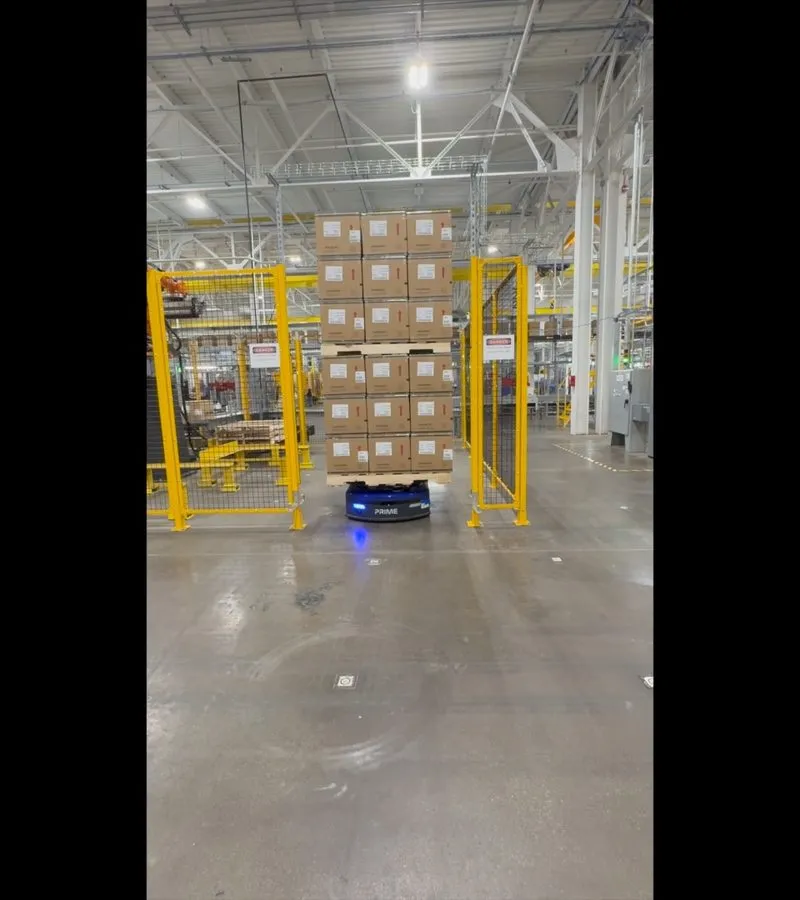
Prime AMR leaving the pick cell. Hybrid SLAM navigation — no floor markers, no fixed grid.
Tell us about your current setup. We’ll come back to you with an honest assessment.
With Prime’s robots and pick stations we were able to do with 1 employee what it would take 6–8 to do before we automated.
We’ll show you the system, walk through the deployment model, and tell you honestly whether the economics work for your situation.