
DSD order profiles, planogram-sequenced pallets, and cold chain to −20°F — Prime handles the order complexity that stops most automation systems.
Handled natively
PES-orchestrated pallet builds
Continuous freezer operation
Live DSD deployment
Most automation systems were designed for full-pallet or full-case throughput. Grocery and retail distribution doesn’t work that way.
DSD operations serve dozens or hundreds of individual store locations. Each store gets a small, precise order — a few cases of this, a few units of that, built on one pallet that has to be right. The order profile is low quantity per line, high SKU count, constant variation order to order.
Retailers also require planogram compliance — product placed on the pallet in the exact sequence it needs to hit the shelf. Get it wrong and the store crew has to break down and rebuild the pallet at the receiving dock.
Add cold chain — produce, dairy, frozen, all in the same operation — and grocery margins that demand ROI from day one, and you have the hardest distribution profile to automate. Most vendors aren’t built for it. Prime is.
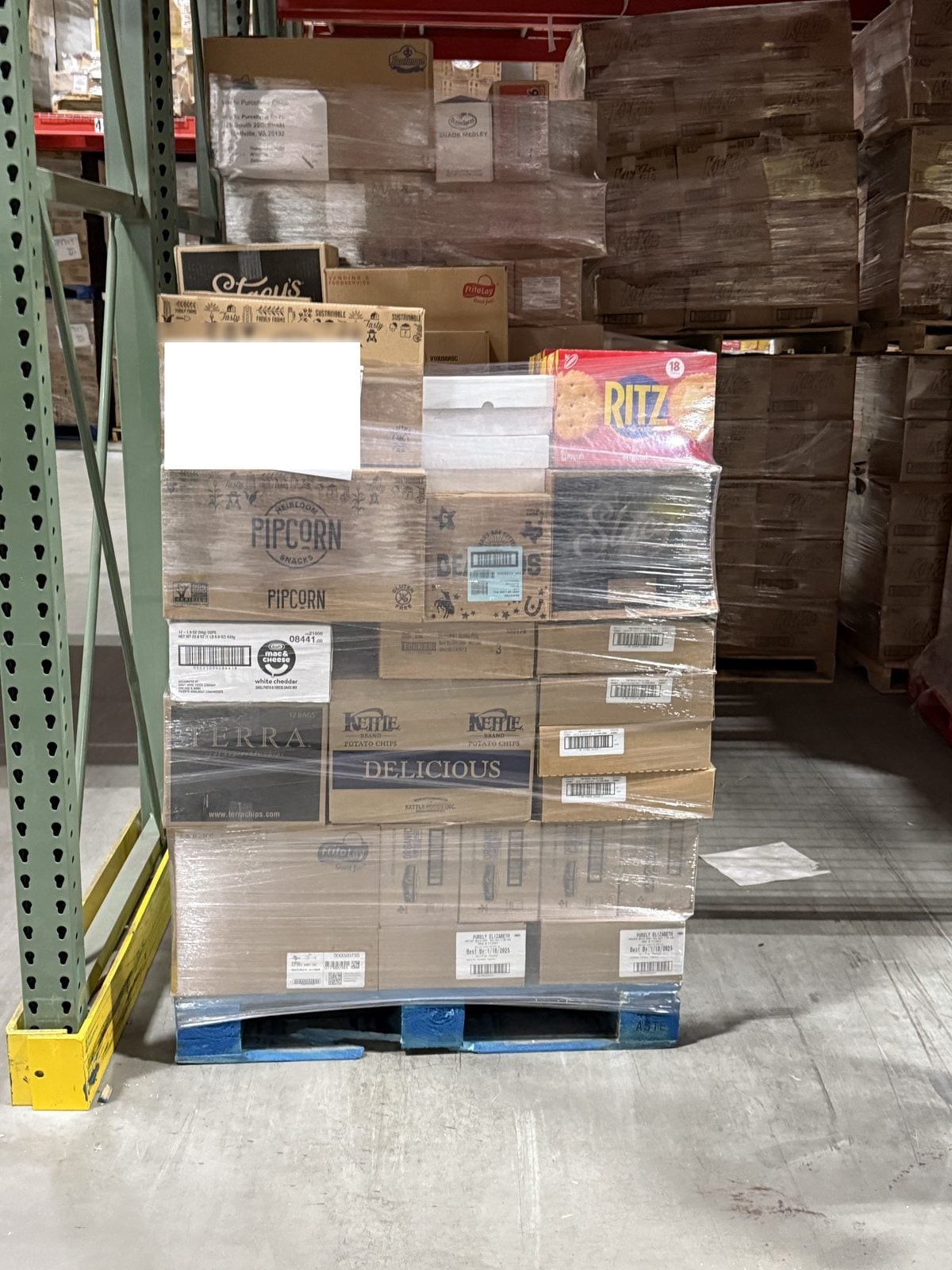
Regional Snack Food Distributor — live DSD deployment
DSD goes to the store, not the DC. Every order is different. Most automation systems break down on this profile. Prime’s Bullseye Scheduling was designed for it.
A DSD pallet for a single store might carry 15–30 SKUs at 1–3 cases per line. The order mix changes every day — different stores, different promotions, different planogram requirements. Systems built for full-pallet or full-case throughput can’t handle this variation without manual intervention.
Prime’s Bullseye Scheduling manages pick sequencing at the individual case level. PES knows every SKU position in the pallet field, assigns picks to minimize travel, and builds the pallet in the correct layer sequence — including planogram order — without a human choreographer.
“The system handles the variation we couldn’t automate anywhere else. DSD profiles that used to require a full picking crew now run with one operator overseeing the entire outbound floor.”
The high-profile failures — large robotic installations shutting down, hundreds of millions written off — have one thing in common. They were built for online grocery home delivery. Centralized, capital-intensive, fixed-infrastructure systems that bet big on home-delivery volume continuing to grow. It didn’t. The economics of shipping individual grocery orders to homes don’t support a $200M warehouse built around a single channel.
That’s a different business than yours.
DSD and traditional store replenishment serves real stores that need product whether or not consumers are ordering online. The labor problem on your outbound floor — chronic unfilled headcount, high turnover, wages that have climbed for four straight years — doesn’t soften when your volume dips. It compounds. And if volume is uncertain, flexible automation that runs on opex and scales with your operation is actually a better bet than fixed infrastructure, not a worse one.
Large centralized fulfillment centers with fixed racking and conveyors, built around a single channel, requiring 18-month installations and investment-grade capital.
Thin grocery margins don’t survive the math of home delivery at scale. The channel didn’t grow fast enough to justify the capital spend.
No racking investment. Robots on the floor. Scales with your operation. RaaS financing turns automation into an operational expense — no capital commitment required to start.
Multi-camera AI confirms what goes on every pallet — before it leaves your dock and long after it arrives at the store.
A DSD pallet ships 15–30 SKUs to a single store. That’s 15–30 opportunities for a wrong case, a missed line, or a quantity error. In a manual operation you can’t verify every pick — you trust your pickers and hope the store doesn’t call. They always call.
APS and TPS stations are ringed with cameras that feed a real-time AI verification layer. Every case placed on the pallet is captured, identified, and counted. Not sampled — every pick, every pallet, every time. If the wrong SKU goes down or the count is off, PES flags it before the pallet wraps. The error gets corrected at the station, not discovered at the store.
After the pallet ships, the complete build record stays in PrimeOS — searchable by order number, pallet ID, or date. When a store contacts you with a shortage claim, you pull up the footage in minutes. If the product was on the pallet, you can prove it. If an error occurred, you know exactly where.
Disputes that used to take days of back-and-forth now take three minutes. You’re not arguing from memory — you’re showing footage.
Wrong SKU or wrong count is flagged before the pallet wraps — corrected before it ships, not after the store calls.
Every pallet build is captured in full — case by case, layer by layer. No spot checks. No gaps.
Pull up the pallet in PrimeOS by order or date. Review the build. The record either confirms the pick or surfaces the error.
Retailers require pallets built in the sequence product needs to hit the shelf. This is an orchestration problem. Most automation systems can’t solve it. PES can.
Planogram compliance means bottom-shelf product loads first, top-shelf product loads last — so when the pallet arrives at the store, the crew can unload directly to shelf in order. Get the sequence wrong and the store receiving team has to break down the pallet, sort it, and rebuild it. That’s labor the retailer didn’t budget for and a relationship problem you can’t afford.
A human picker building pallets manually gets the sequence wrong regularly. A static automation system — one without real-time orchestration — can’t sequence picks dynamically because it doesn’t know the planogram. PES knows the planogram from the order and directs every pick in the right order. The pallet is built correctly the first time, every time.
Pick robots and conveyor systems move product. PES tells them what to move, in what order, and why. Planogram sequencing requires knowing the shelf layout, mapping it to the order, and directing picks accordingly — in real time, across hundreds of SKUs. That’s not a robot capability. That’s a software capability. PrimeOS has it.
The order includes SKU quantities and the shelf position each SKU needs to land on. PES maps product to position.
Bottom-shelf SKUs are picked first, building pallet layers from the ground up. Top-shelf SKUs are last. The pallet build sequence matches the unload sequence at the store.
MobilePallet robots retrieve cases in the exact order PES directs. No human staging, no manual sort step, no re-stack at the dock.
Store crew unloads directly to shelf in planogram order. No pallet breakdown. No extra labor. No retailer complaints.
Grocery cold chain isn’t one problem — it’s three. Produce, dairy, and frozen each require different temperature management. Arctic Series handles all three, including the hardest: −20°F continuous operation.
Fresh produce and refrigerated goods. Arctic Series robots operate at refrigerated temperatures without performance degradation.
Dairy distribution requires consistent cold chain without gaps. Same PES orchestration, same robot fleet, same workflow — at dairy temperatures.
The hardest zone. Arctic Series robots are rated for continuous operation at −20°F. 6–8 hours of battery runtime. Nobody should work in the freezer anymore.
The same PrimeOS platform that orchestrates ambient warehouse operations runs the cold chain. No separate software, no separate robot types to manage. One system from receiving dock to frozen dispatch.
Grocery distribution centers reconfigure constantly. Seasonal product, new store layouts, new client contracts. Prime doesn’t require a racking investment — robots navigate a pallet field on the floor.
Fixed racking infrastructure locks you into a layout that made sense when you installed it. When the product mix changes — and in grocery it always does — you’re stuck paying to reconfigure hardware or living with a suboptimal layout.
Prime robots navigate a pallet field using SLAM + QR localization. No racking, no fixed paths, no specialist programmers required to reconfigure. When the operation changes, Site Manager updates in software. The robots adapt.
Low qty per line, high SKU mix — handled natively by Bullseye Scheduling. No manual pick choreography.
PES directs every pick in shelf sequence. Pallets arrive store-ready — no dock re-stacking required.
Continuous operation at −20°F. Same PrimeOS platform, same workflow — produce, dairy, and frozen covered.
SLAM + QR navigation on the floor. Reconfigure in software when product mix or store layouts change.
Live DSD deployment — Regional Snack Food Distributor. Outbound floor now runs with one operator.
Robotics-as-a-Service. Operational expense model — no capital budget required to get started.
DSD, planogram compliance, cold chain — describe what you’re running and we’ll tell you exactly how Prime handles it.
No commitment. We’ll review your order profile and respond within one business day.