
Robot arms that pick layers and cases. MobilePallet AMRs that move product between every station. PES orchestrating the sequence. One system — not one arm.
Cases per hour outbound throughput
Max finished pallet height
Touches with Bullseye Scheduling vs. ~45 traditional
Labor ratio — regional distributor, Allen, TX
A single arm. A single station. A single order profile. That works when your operation is uniform SKUs at standard heights with consistent order patterns. Most operations aren’t.
When order types mix — some layers, some individual cases, some tall pallets — a single-station palletizer routes exceptions back to manual labor. You end up with a partially automated outbound operation that still requires full staffing for the hard orders.
The real problem is architecture. Most robotic palletizers were designed as machine replacements, not as systems. They don’t move pallets between stations. They don’t sequence work across arm types. They don’t adapt when the order profile changes.
One order needs a full layer. The next needs individual cases. One arm can’t handle both efficiently.
108″ pallets with 25+ SKUs at low quantities per line. Most automated systems walk away from this.
Without AMR transport, every station handoff needs conveyors or forklifts — which limits where automation can go.
WMS wave batching exists because transport-distance constraints force it. PES eliminates the constraint.
Traditional approach: build a full pallet, pull 5 exceptions manually — ~45 unnecessary touches per pallet.
Layer pick, case pick, and APS in one order requires an orchestrator. A standalone arm can’t sequence across station types.
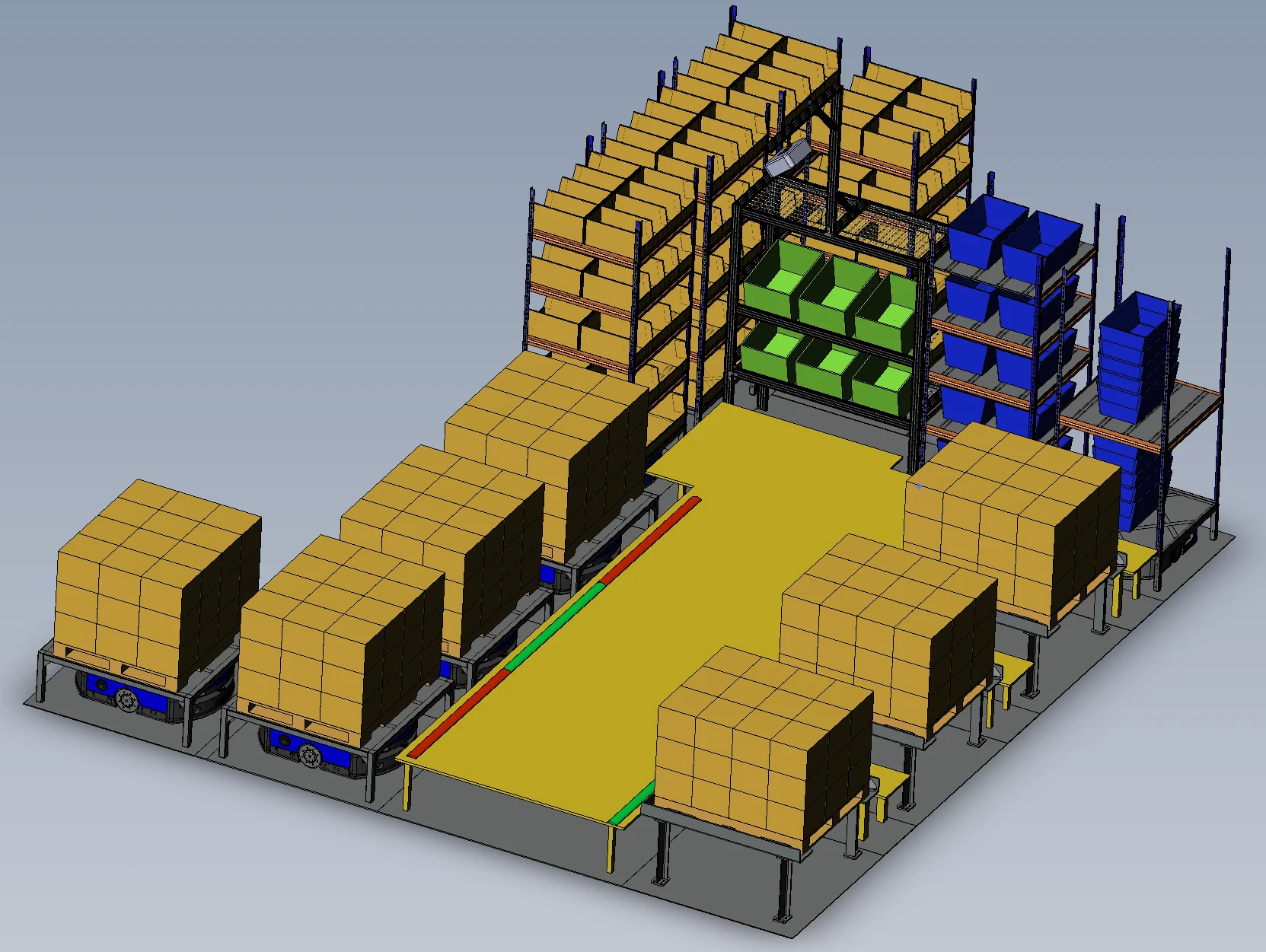
Layer & case pick arms with MobilePallet AMRs in queue
APS with LED pick-to-light rails — AMRs delivering inbound pallets
Prime builds palletizing as a system, not a machine swap. MobilePallet AMRs move pallets between every station. PES orchestrates the sequence. The station stack handles whatever the order requires.
Moves pallets to and from every station in the palletizing system — no fixed conveyors, no forklift trips between steps. The MobilePallet carries up to 4,400 lbs and handles 108-inch finished pallets, moving them from the station to staging, stretch wrap, or dispatch. Pallet transport is solved in software, so the system reconfigures without infrastructure changes.
Picks full product layers off a donor pallet in a single motion — the highest cases-per-hour rate for uniform SKU order profiles. PES routes orders to the layer pick arm when the order profile supports it. An order can route through both a layer pick arm and a case pick arm in the same workflow; PES handles the sequencing and MobilePallet handles the transport between them.
Picks individual cases — the right tool for mixed SKU pallet builds where a layer arm can’t operate. PES sequences case pick work so the arm is always building toward a specific outbound pallet, not building inventory. Where a layer arm sees one SKU, a case arm sees an order. Both can be active on the same workflow.
The Tall Pallet Station (TPS) handles pallet builds up to 108 inches with 25+ unique SKUs and low quantities per line. The Advanced Pallet Station (APS) handles standard-height builds. Both operate as stops in a PES-orchestrated workflow. A single order can touch TPS, APS, and a case pick arm in sequence — with MobilePallet handling every pallet move between them.
Most palletizing software takes the obvious route: build the full pallet, then go pick the exception cases manually. If a 50-case donor pallet needs 5 exception cases removed, the system picks all 50 — a worker pulls 5 — and 45 cases moved that didn’t need to.
Bullseye Scheduling reverses it. PES identifies the ~5 exception cases first, picks those, then uses the remaining donor pallet as the starting point for the outbound build. The pallet that was going to be rebuilt from scratch becomes the build start.
The result: ~45 touches becomes ~5. The donor pallet does double duty. And the arm spends its cycles building product outbound — not managing inventory that was going to move anyway.
Touch-points per pallet. Build full, remove exceptions, re-stage donor.
Exceptions picked first. Donor pallet becomes build start. Arm cycles go outbound.
WMS wave batching exists because transport-distance constraints force orders to group. When MobilePallet AMRs remove that constraint, PES sequences work order-by-order — no wave batching required. Orders release continuously, and the station mix always works the highest-priority outbound pallets.
A standalone arm only does what that one station does. PES sequences a single pallet build across multiple station types — no manual handoffs, no re-queuing, no operator routing decisions between steps.
Full layers placed on outbound pallet
AMR moves partial build to next station
Mixed SKU cases added to build
Pallet structure completed and confirmed
MobilePallet moves finished pallet to staging
This is what “system” means versus a standalone arm. PES owns the sequence. Each station type does what it does best. MobilePallet handles all transport. No operator decides what goes where — and no conveyor system connects the pieces.
Station breadth is where throughput is won. Each station type handles what the others can’t — and PES sequences work across all of them in a single workflow.
Full-layer picks off a donor pallet. Highest CPH for uniform SKU profiles. PES routes automatically when order supports it.
Individual case picks for mixed SKU outbound builds. Sequences alongside layer pick and APS in one PES workflow.
Mixed-SKU pallets up to 108 inches. 25+ unique SKUs, low quantities per line, mixed case dimensions — the workflow nobody else automated.
Standard-height pallet builds. Operates as a step in PES-orchestrated mixed queue workflows alongside layer pick and case pick arms.
Nine people doing what one person does now. Regional paper & packaging distributor, Allen, TX. Full Prime palletizing system deployment including robot arms and MobilePallet AMR transport.
“We were running multiple manual palletizing lines with full crews. The question wasn’t whether to automate — it was whether automation could actually handle our order profile. Prime was the only system that could handle all of it without leaving exceptions back on the floor.”
Quote pending final customer clearance — placeholder in use until confirmed.
Mixed order types, tall pallet builds, or exception-heavy outbound workflows — the walkthrough shows exactly how PES sequences it and what the station stack looks like for your operation.