
Manual and static palletizing systems typically top out at 100–150 cases per hour in real mixed-SKU outbound conditions. Bullseye Scheduling eliminates arm idle time entirely — 400–600 CPH, sustained, across variable order profiles and donor pallet arrival.
Cases per hour
Bullseye Scheduling
CPH typical
manual / static systems
Station types
orchestrated by PES
Live deployments
running today
Mixed-SKU outbound — variable order profiles, donor pallets arriving out of sequence, cases that an arm can’t reliably pick — is where automation projects stall. We built the platform for what comes after.
Pallet-building labor is expensive, inconsistent, and error-prone at volume. The problem isn’t effort — it’s that no one has built the right system for your order profile. The ceiling isn’t your team; it’s the architecture you’re trying to automate.
Competitor arms hit a ceiling because the scheduling logic is static. The arm waits for a donor pallet that hasn’t arrived, or cycles through a pick plan built at batch time with no ability to rebalance in real-time. The arm isn’t the problem. The orchestration is.
The same APS, arm, and TPS station types that run in ambient warehouses run in cold and frozen environments with Prime’s Arctic Series robot fleet. The stations don’t change — the robots are rated for it. Most automation vendors won’t commit to sub-freezing. We’ve deployed there.
Not every SKU in a mixed-pallet order is arm-pickable. Irregular dimensions, inconsistent surfaces, bags — these get routed to the Advanced Pallet Station, where a directed worker handles them at engineered ergonomics. No pick gets left behind.
Bullseye Scheduling isn’t a marketing name. It’s a specific orchestration architecture inside PES that addresses the three reasons static palletizing systems fall short at volume.
Static systems build a pick plan at the start of each wave and execute it. When donor pallet arrival varies — which it always does — the arm sits idle waiting. PES eliminates waves entirely. Orders are deconstructed into individual picks, prioritized continuously, and dispatched to the station that’s ready right now.
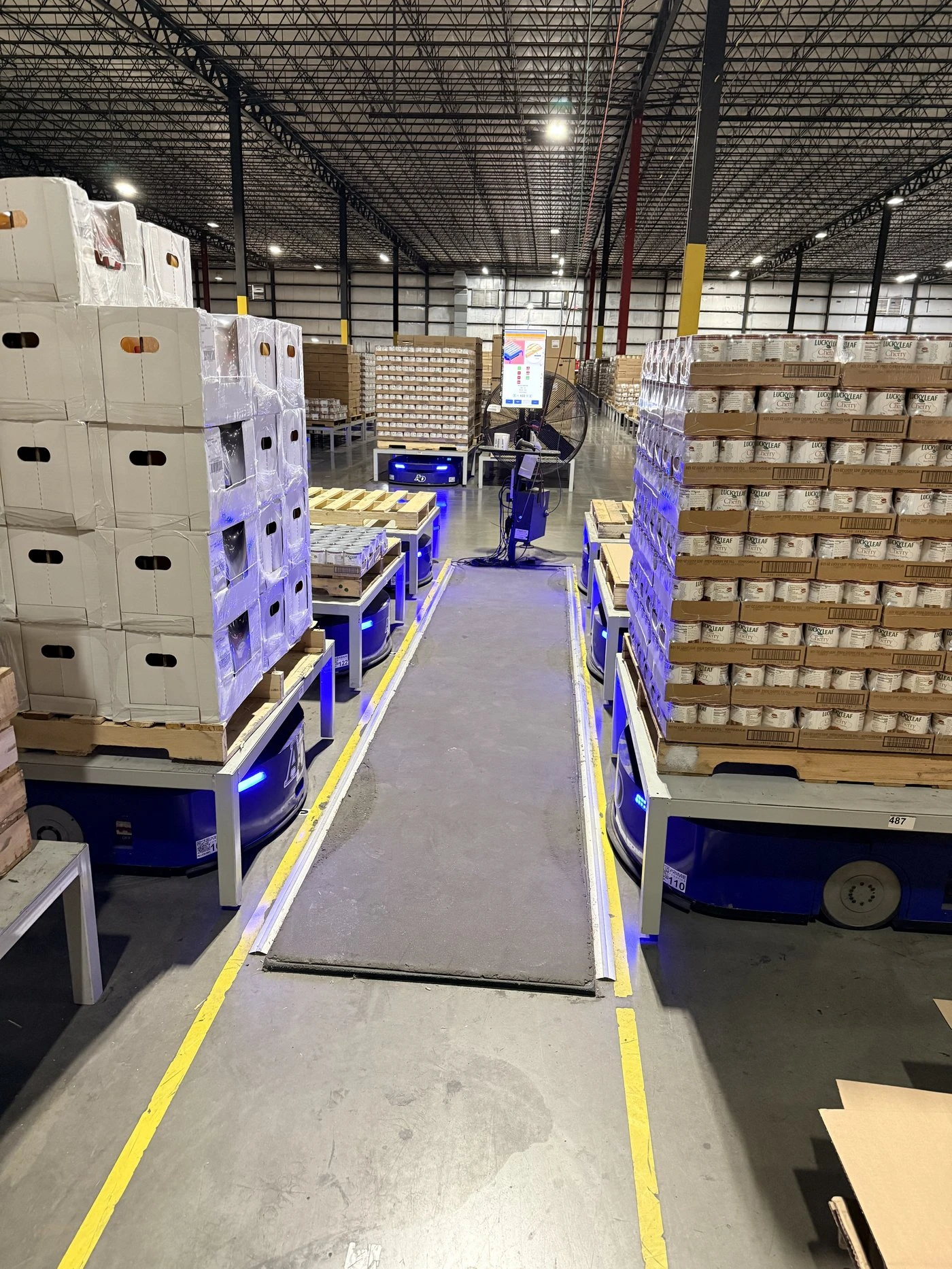
In a traditional case-pick arm setup, the arm makes roughly 45 trips to position — moving to each donor pallet in sequence to pick one or two cases. Bullseye Scheduling inverts this: AMRs bring donor pallets to the arm’s working zone. The arm stays stationary. Trip count drops from ~45 to ~5 per pallet build.
PES assigns AMRs as resident or dynamic — resident units cycle continuously for one station, dynamic units float across stations to where utilization is highest. When order mix shifts throughout the day, assignment logic adapts in software. You change a workflow parameter, not hardware.
Most robotic palletizing vendors sell you one station type — an arm, a layer picker, or a human-directed station. If a SKU can’t be handled by that station, it falls outside the automated system. Your team manages the gap manually. That’s not a solved problem. That’s a different problem with extra steps.
Prime’s approach is fundamentally different. PES treats the outbound pallet as a single work order that can route across multiple station types in sequence — in any combination, in any order — based on what each SKU actually needs.
If a SKU can’t be picked by the arm — irregular dimensions, bags, fragile cases — it exits the system. Handled outside, manually, without scan confirmation or build-state tracking. Your team becomes the integration layer between their product and your operation.
Non-pickable SKUs don’t exit the system — they route to the right station. The pallet build continues. One system owns the full workflow from first case to completed outbound pallet, regardless of how many station types it touches.
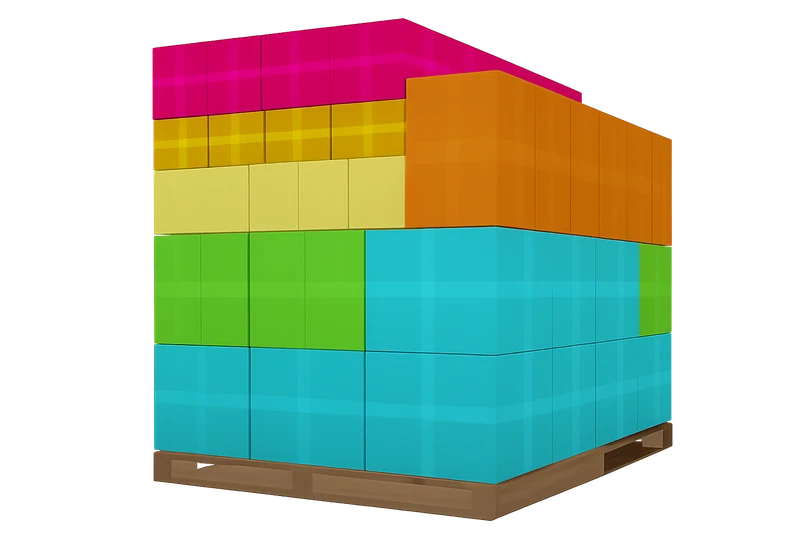
Full layers of consistent-case SKUs applied to pallet base. Fastest possible CPH for high-volume uniform cases.
Arm-pickable individual cases added. Bullseye Scheduling keeps the arm running — donor pallets arrive, arm stays stationary.
Hard-to-pick SKUs — bags, irregulars, fragile cases — handled by a directed worker. Scan-confirmed. PES-tracked. In-system, not outside it.
Pallet returns to arm for final case picks. The same outbound pallet. The same build order. PES tracks build state across every station transition.
PES holds the build state across every station transition. When the pallet moves from the arm to the human station and back, PES knows exactly what’s been placed, what’s remaining, and where the pallet is in the build sequence. No manual reconciliation. No handoff gaps. One system owns the entire outbound pallet from first case to dispatch.
Labor cost and throughput are why people start the conversation. Accuracy is why they close it. A system that ships wrong product at high speed costs more than it saves. PES enforces accuracy at every station, every pick, every pallet.
Every pick at every station requires a barcode scan confirmation before the system advances. No scan, no next task. PES won't let the workflow continue until the right case is confirmed. The operator can't skip it, and the arm can't overpick.
Site Manager captures a timestamped record of every task: which robot moved which pallet to which position, which worker confirmed which pick, and when. If a pallet leaves the building wrong, you know exactly where and when it diverged. Disputes with retailers get resolved with data, not guesswork.
When a donor pallet arrives damaged, a SKU scans out of tolerance, or a station goes offline, PES doesn't freeze — it reroutes. Tasks queue to the next available station and the system continues running. No manual intervention required to keep the floor moving.
A directed work station where a single operator handles arm-non-pickable cases — irregulars, bags, fragile items — while AMRs deliver donor pallets continuously to an ergonomic working height. PES directs every pick with scan confirmation and manages pallet build state across multiple concurrent outbound pallets.
An industrial robot arm running Bullseye Scheduling — donor pallets delivered by AMR to the arm’s fixed working zone, eliminating positioning travel. Handles reliably-pickable case profiles at maximum throughput. When the order mix includes unpickable SKUs, PES routes those automatically to APS without interrupting the arm.
A full robotic cell for low-quantity-per-line, 25+ SKU, up to 108″ outbound pallets — the order profile no other system handles. One worker on an elevated platform builds multiple pallets simultaneously while MobilePallet robots cycle source pallets continuously. PES manages build sequencing across all concurrent outbound positions.
Handles full-layer picks of uniform-case SKUs — the fastest possible CPH for high-volume consistent cases. In a mixed queue build, the pallet often starts here, getting several full layers applied before routing to the case pick arm or APS for individual SKU picks. PES sequences the handoff automatically.
You don’t need a full build-out to start capturing value. The platform is modular by design — each step adds throughput without requiring you to rip out what came before.
📋
Workers building pallets directed by PES — scan confirmation, task sequencing, build state tracking. No robots yet. Accuracy goes up immediately. The data foundation is in place.
🤖
MobilePallet robots take over donor pallet transport. Workers stop walking the floor chasing product. Labor hours drop. Throughput climbs. PES orchestrates robot and worker tasks from one system.
⚙️
Case pick arm comes online, running Bullseye Scheduling. AMRs that were moving pallets for workers now deliver to the arm’s fixed zone. Unpickable SKUs route automatically to APS. The full system is live.
📈
PES captures utilization data across every robot, station, and pick. WorkFlow Builder lets your team adjust task logic, assignment rules, and throughput targets in software — without touching hardware.
100–150 CPH
400–600 CPH
The gap is real. Manual palletizing and single-arm static systems both hit a ceiling in mixed-SKU conditions — non-pickable SKUs fall outside the system, arm idle time accumulates, and wave-based planning can’t adapt to donor pallet arrival variability. Bullseye eliminates the idle and routes every SKU through the right station.
The dedicated microsite walks through every zone in the Bullseye Scheduling architecture — how donor pallet flow, arm positioning, and AMR assignment work together at the pick level — with throughput benchmarks and configuration options.
Our team has deployed mixed-SKU palletizing across distribution, food & beverage, and cold storage environments. If your operation fits the model, we’ll tell you directly — along with what it takes and what you should expect.
We respond within one business day. No sales pressure — if your operation isn’t a fit, we’ll tell you that too.