Factory Automation. Without LockingIn Your Layout.
Most factory AMR vendors sell you fixed-path robots that need a specialist to reprogram when your line changes. Prime’s PES is a workflow composition engine — reconfigure in software, not hardware.
Factory floors don’t sit still. New product lines, shifted workflows, retooled stations — every change means a reconfiguration project. With most AMR vendors, that means engineers, timelines, and cost overruns.
Fixed Infrastructure
Your Line Changes.
Your Robots Can't.
Fixed-path AGVs and tape-guided AMRs require physical re-routing every time production changes. What’s sold as “automation” becomes a constraint that slows your ability to adapt.
Software Fragmentation
Three Vendors,
Zero Ownership.
A robot vendor, an integration partner to wire it to your ERP, and your IT team — each pointing at the others when throughput drops. Every competitor assumes a system integrator will connect their robots to your systems. That’s a second project, a second contract, and a second point of failure.
Payload Gap
Warehouse Robots
Can't Move Factory Loads.
Most warehouse AMRs top out at 500–800kg. Factory pallets, raw material sleds, and heavy components routinely exceed that. Your floor needs a different class of robot — few AMR vendors have it.
Forklifts
at the Dock.
AMRS OWN THE FLOOR.
Keep Forklifts
Where They Belong.
Forklifts are built for loading docks — unloading trucks, staging inbound freight, moving heavy loads from the yard. The moment they’re running point-to-point missions inside the facility — station to station, line to line, shift after shift — you’re using the wrong tool. AMRs handle every internal transfer autonomously, so your forklifts stay at the dock and your operators stay off the floor traffic.
The Prime Answer
Four Building Blocks.
One System.
PES isn’t a robot controller — it’s a workflow composition engine. Assemble the factory automation workflows your operation needs from four proven building blocks, then reconfigure in software when the line changes.
01 — STORAGE
RackBot ASRS
High-density input buffer for raw materials and WIP. PES pulls from RackBot when the line needs replenishment — no manual staging area required.
02 — PROCESSING
Hybrid Kitting Station
Breakdown and kitting at the point of need. The APS station accepts inbound loads and presents components to operators in the right sequence.
03 — TRANSPORT
Point-to-Point AMR
MobilePallet AMRs move kits, components, and sub-assemblies wherever the line needs them. SLAM navigation handles mixed-traffic factory floors without tape or fixed paths.
04 — INTEGRATION
ERP / MES via API
PES reads production missions directly from your ERP or MES via API. When the schedule changes, PES reconfigures the workflow — no reprogramming, no downtime.
PROOF
Live Deployment
Running Across 12 Deployments in Production Today
From manufacturing facilities to food & beverage distribution — Prime’s factory AMR system is running live workflows across a range of production environments.
12
Live deployments in production
4
Concurrent workflow types from one PES instance
1
Vendor accountable for robots + software + support
How It Works
The Factory Automation Workflow,
Step by Step
01
ERP / MES → PES
Missions Arrive in PES
Your ERP or MES pushes a production mission via API — a replenishment request, a kitting run, a return cycle. PES breaks it into a concrete sequence of robot tasks and dispatches them to the fleet. No manual boards, no radio calls. If the production schedule changes mid-shift, PES updates the queue automatically.
Point-to-Point · SLAM Navigation
Robot Moves Freely Between Zones
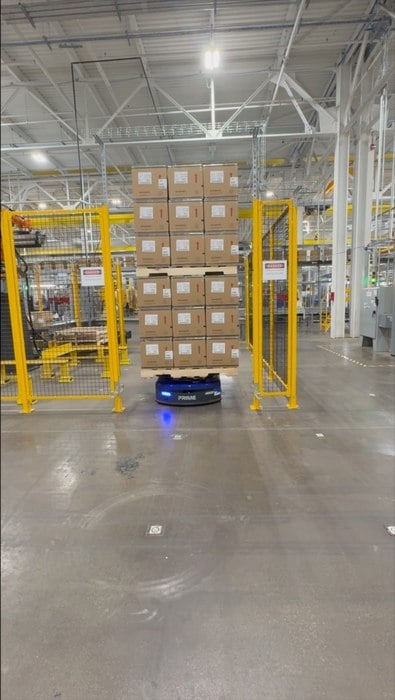
A MobilePallet AMR navigates autonomously through the factory — carrying full loads through yellow safety gates, across production zones, alongside forklifts and pedestrians. Prime uses both SLAM and QR navigation, and switches between them automatically: SLAM handles mixed-traffic aisles and zone-to-zone movement where paths are dynamic; QR codes take over at kitting stations and storage transfer points where precise, repeatable positioning matters. You get the flexibility of free navigation and the precision of a fixed-path system in the same robot.
02
Navigation Technology
QR Precision Where It Counts. SLAM Freedom Everywhere Else.
QR-Guided
Kitting stations, ASRS transfer points, conveyor docks — anywhere sub-centimeter repeatability matters. The robot locks to a QR code and positions precisely, every cycle.
SLAM Navigation
Factory aisles, forklift corridors, zone transitions — dynamic pathfinding that adapts to real traffic in real time. No tape, no fixed paths, no infrastructure changes when your layout shifts.
03
Point-to-Point Drop-Off
Product Drop-Off at the Station
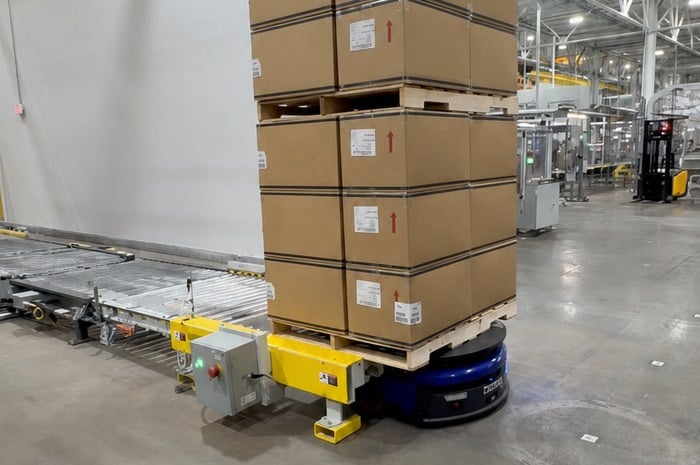
The AMR carries its load across zones and approaches the drop-off station through the zone doorway. PES tracks the load in real time, routes around competing tasks and floor traffic, and queues the next mission the moment the drop-off is confirmed — no wait, no manual handoff.
Components · Kits · Parts
Product Delivered to the Line
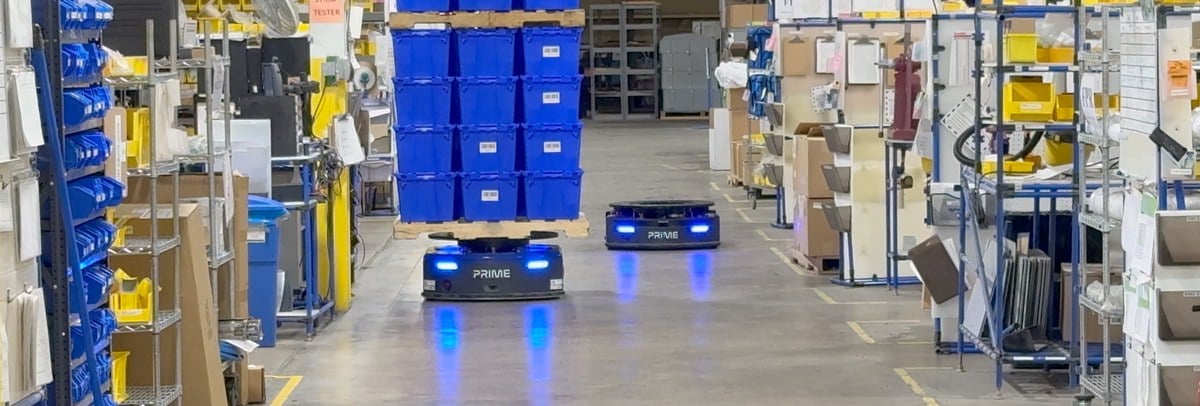
AMRs move kitting totes, components, raw materials, and sub-assemblies wherever the production line needs them. One robot loaded, one already returning empty — PES coordinates the fleet so the right material arrives at the right station at the right time, without operators chasing stock or waiting at the line.
04
05
Kitting Station · PES Interface
Delivered to the Station,
Ready for the Operator
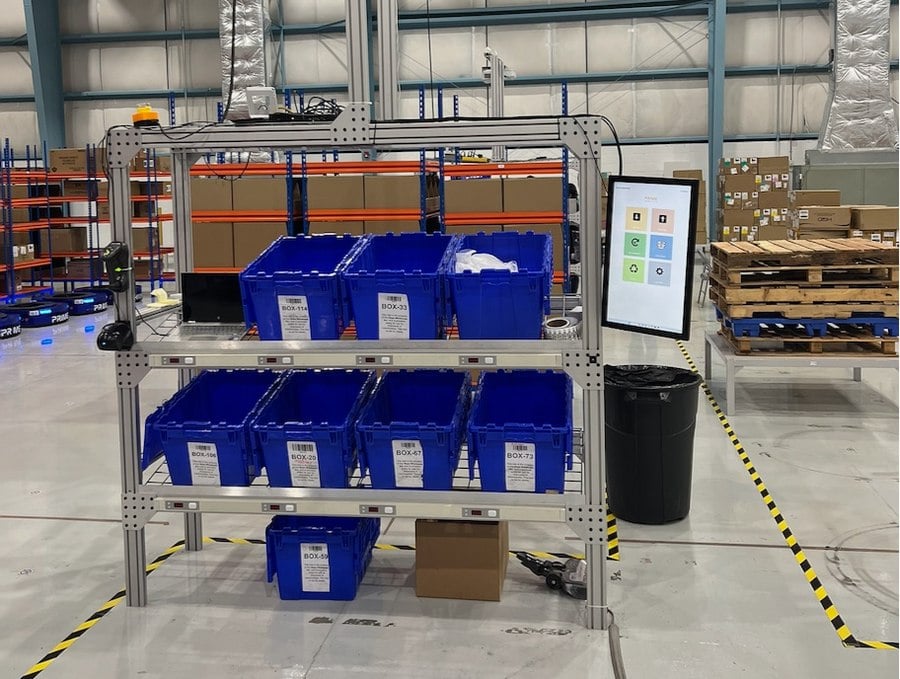
The AMR delivers directly to the kitting station. Totes are labeled and positioned for the operator — the PES tablet shows the active mission, pick sequence, and status. No paper, no radio dispatch. When the station completes its task, PES dispatches the next mission automatically.
Return Flow
Empty Return, Automatically
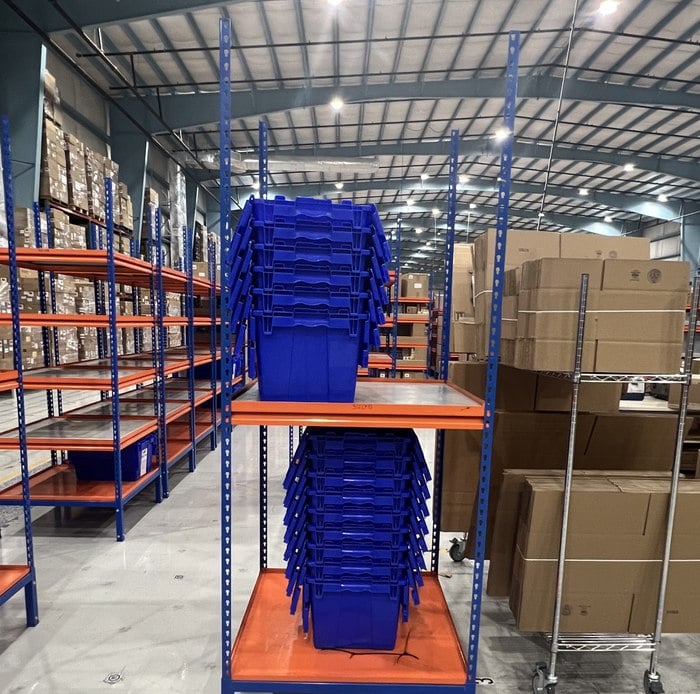
When a tote empties at the line, PES dispatches a return mission. The AMR collects the empty and routes it back to the buffer staging rack — no operator intervention, no accumulation of empties blocking production aisles. Totes nest and stage ready for the next kitting run.
06
07
PES WorkFlow Builder
Reconfigure When the Line Changes
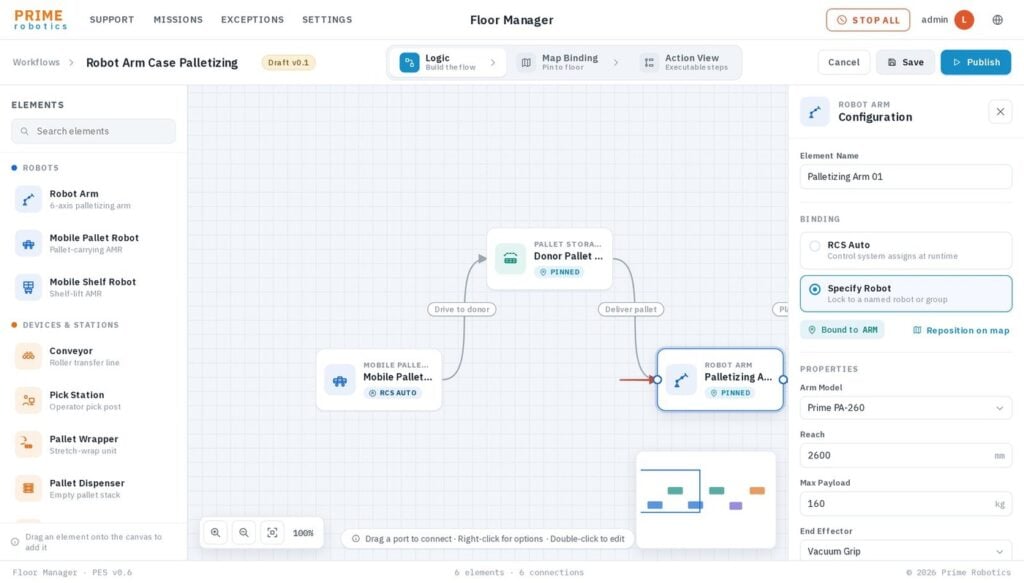
New product line? Shifted station layout? Open WorkFlow Builder in PES, drag the updated sequence, publish. Factory automation robots execute the revised workflow on the next mission cycle — no engineers, no downtime, no vendor call required.
PES Software
The Brain That
Runs
All of It
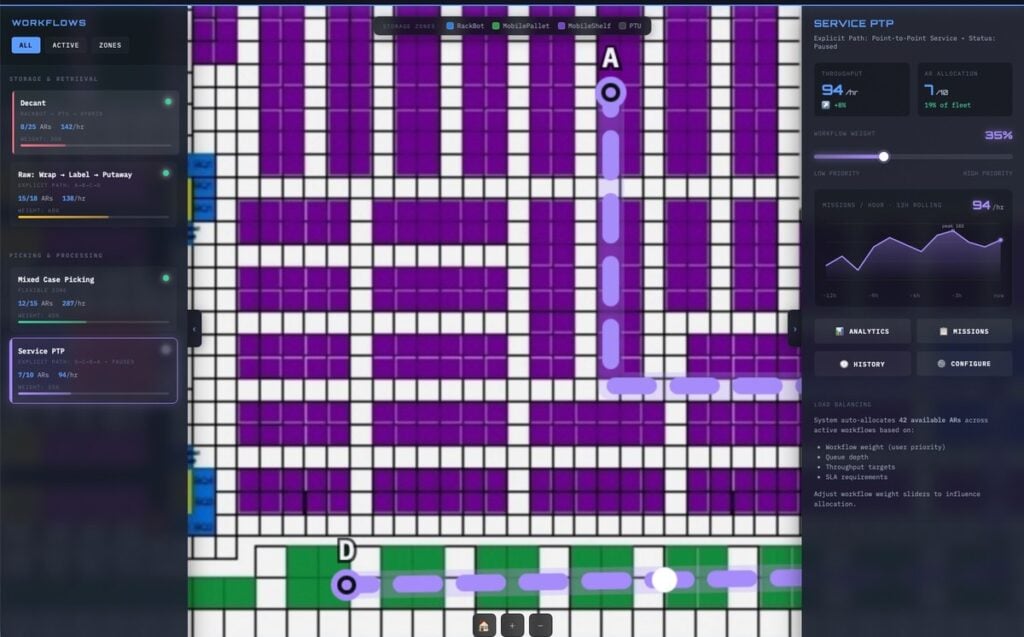
One software layer orchestrates every robot, station, and third-party device in your factory. Create workflows, monitor execution, see throughput in real time, and watch robot allocation shift dynamically across active missions.
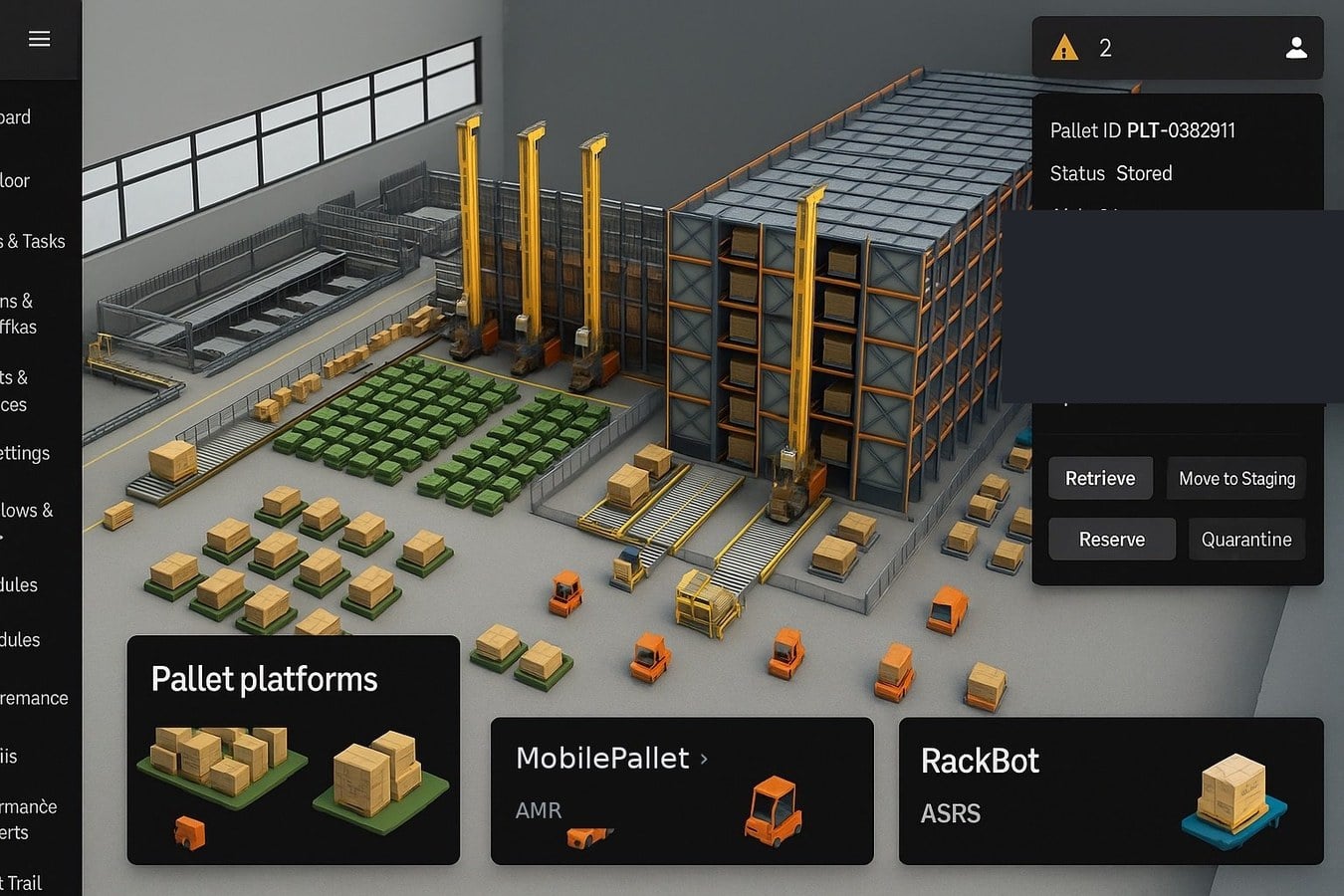
PES Site Manager — a live 3D digital twin of your entire operation. Every robot, every pallet, every task visible in real time. Click any asset to see its status, location, and mission. Exceptions surface immediately so your team can act, not hunt.
WorkFlow Builder
Drag-and-drop factory workflow composition. Build kitting, point-to-point, and return flows without code.
Site Manager
Live floor map with every AMR, task, and zone visible. Exceptions surface immediately across all workflows.
ERP / MES API
Bidirectional integration with SAP, Oracle, NetSuite, and custom MES systems — missions flow directly into PES.
Robot Allocation
System auto-allocates AMR fleet across workflows by priority weight, queue depth, and throughput targets.
Private Walkthrough
See How Your Factory Floor Would Run
We’ll walk through how PES would orchestrate your specific workflows — kitting, point-to-point transport, ERP integration — using your operation as the example. No sales deck. No generic demo.
No commitment required. We’ll reach out within one business day.