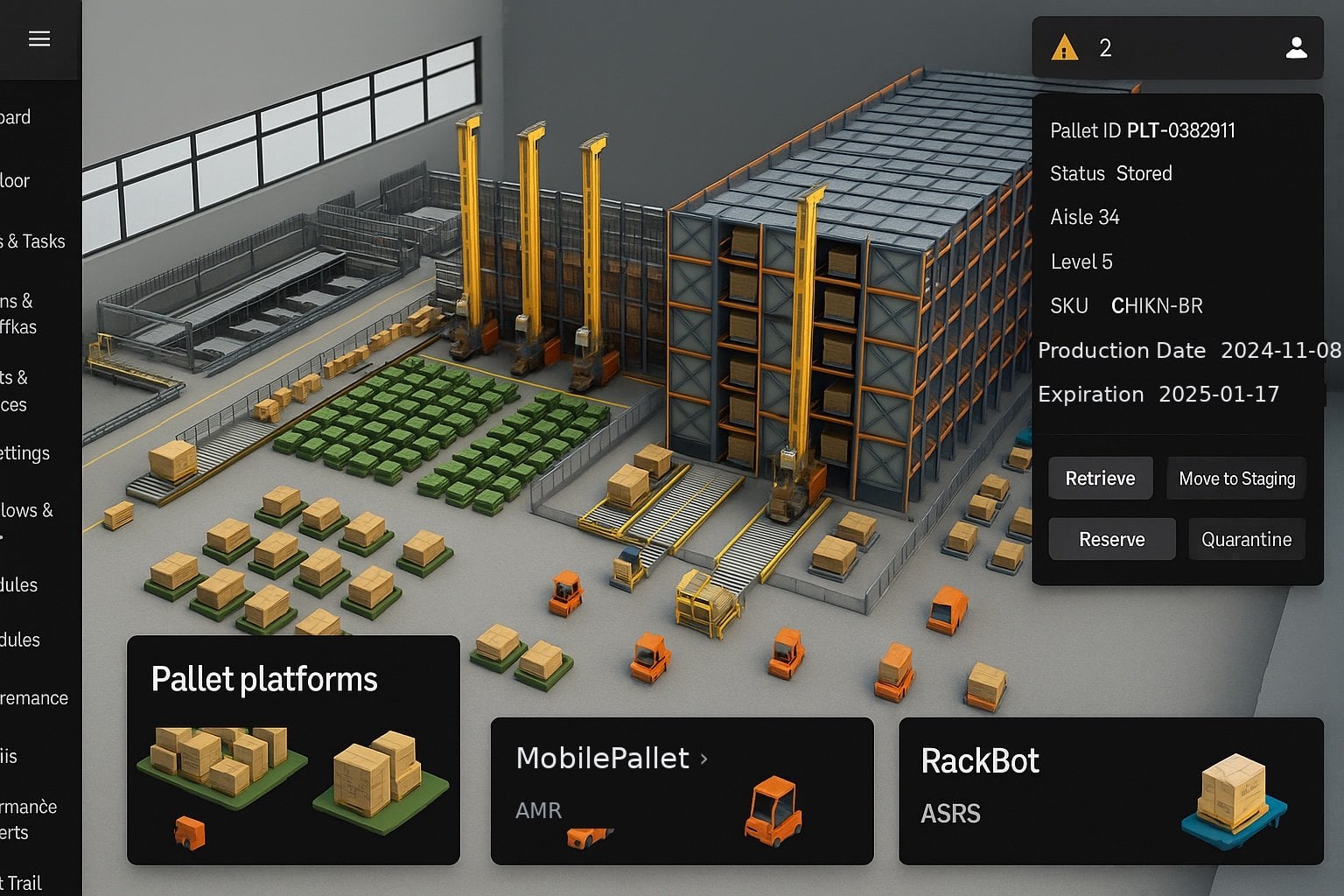
The only platform that runs your entire floor — every robot, every station, and the third-party equipment you already own — as one operation, in real time. Prime and non-Prime alike.
Live Deployments
Platform for every robot, every station, and the equipment you already own
Live deployments across 3PL, food & beverage, and manufacturing
Labor ratio achieved on a live deployment floor
Middleware required — PrimeOS connects directly to your WMS
Most automation forces a choice. Buy into one vendor’s closed ecosystem and live inside its limits — it won’t touch anything it didn’t build. Or stitch together point solutions and turn your best people into full-time integrators, babysitting the seams between systems that were never meant to talk.
A single-vendor system only orchestrates its own hardware. The ASRS you already own, the palletizer from another supplier, the arms from a third — none of it fits. So you rip out working equipment to match the vendor, or you leave it stranded on an island the platform can’t see.
A WMS for orders. A WCS for conveyors. A robot vendor’s app for robots. A separate dashboard for each. Every integration is a custom project, every upgrade is a risk, and one person on your team quietly becomes the glue holding it all together.
wraps any device with a PLC or API and makes it a first-class object on your floor — indistinguishable, to the platform, from a Prime robot. A competitor’s ASRS, a Fanuc arm, a Wulftec wrapper, a CubiScan dimensioner, a conveyor line:
orchestrates all of it in real time, alongside the Prime fleet, as one system.
That’s the difference. Prime walks onto a floor that already has equipment on it and makes that equipment part of the operation — no rip-and-replace, no custom integration project for every device. The wrappers ship with the platform. You show us what’s on your floor; runs it.
MobilePallet, MobileShelf, and RackBot — orchestrated natively across all 17 station types and every fleet configuration, including Arctic Series for freezer zones.
AutoStore and crane-based ASRS, robotic arms, conveyors, stretch wrappers, dimensioners, AGV forklifts — the equipment you already own becomes a first-class object.
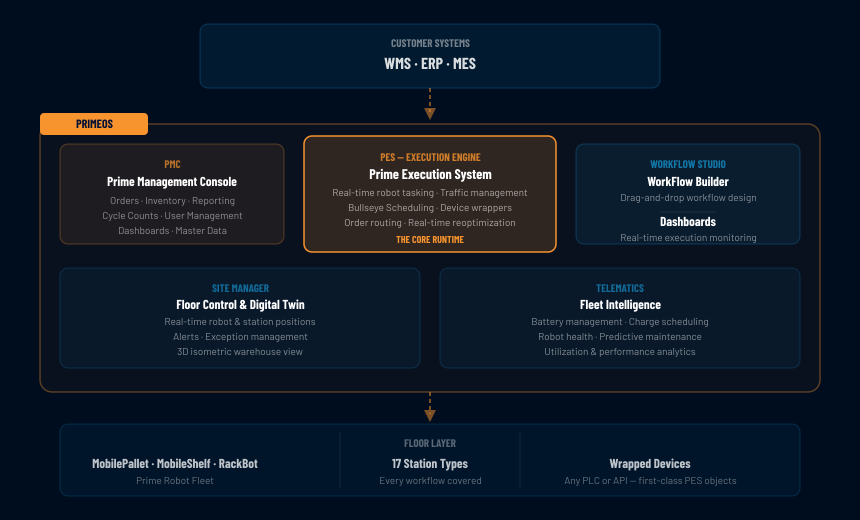
Manhattan, Blue Yonder, SAP EWM and ERP, MES. sits below your system of record and executes against it — no middleware layer to build or maintain.
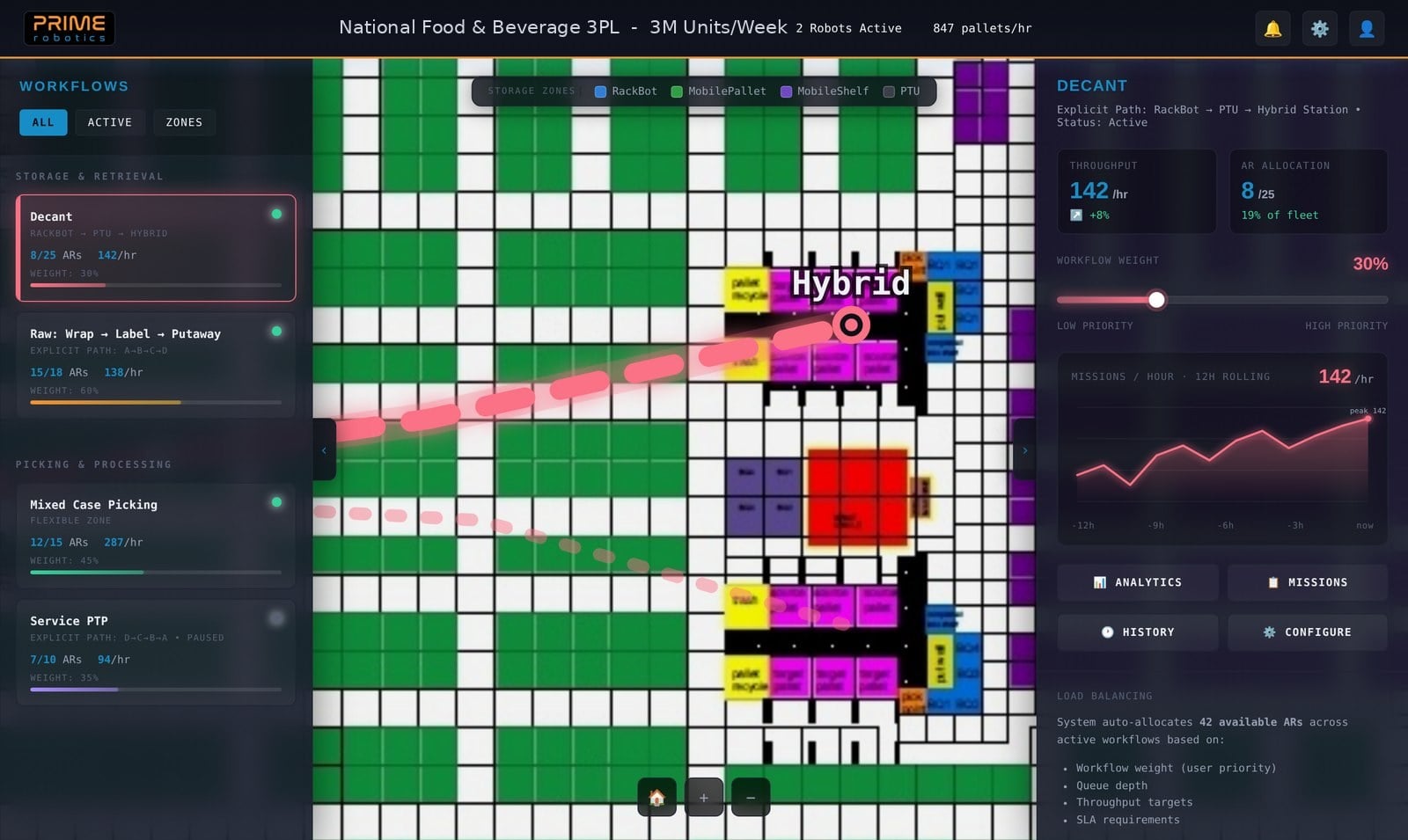
That’s a claim about us. Here’s what it means for you. PES is the real-time engine underneath every other application in PrimeOS — it takes work from the floor’s live state and orchestrates every robot, station, and wrapped device against it, continuously and all at once. Below is what that buys you on the floor — and why a single-vendor or point-solution buyer can’t get there.
Executes against live floor conditions — not a plan computed an hour ago.
Any device with a PLC or API becomes a first-class object PES tasks directly.
Dynamic pallet-build sequencing that adapts as the order mix moves.
Every robot type coordinated in one flow — no collisions, no idle capacity.
Pallets, cases, eaches, and kits routed through the same live system.
PES is the core. Four applications sit around it — so managers, supervisors, and engineers each run the operation from where they work.
PES runs the floor. These four applications are how your people reach it — each built for the person who uses it, from the operations director to the operator at the station.
Where managers and operations directors run the floor daily — orders in from your WMS, inventory positions, cycle counts, reporting, and the live performance data that tells you whether today is on track. Not a WMS replacement; the layer that turns your WMS’s intent into executed work.
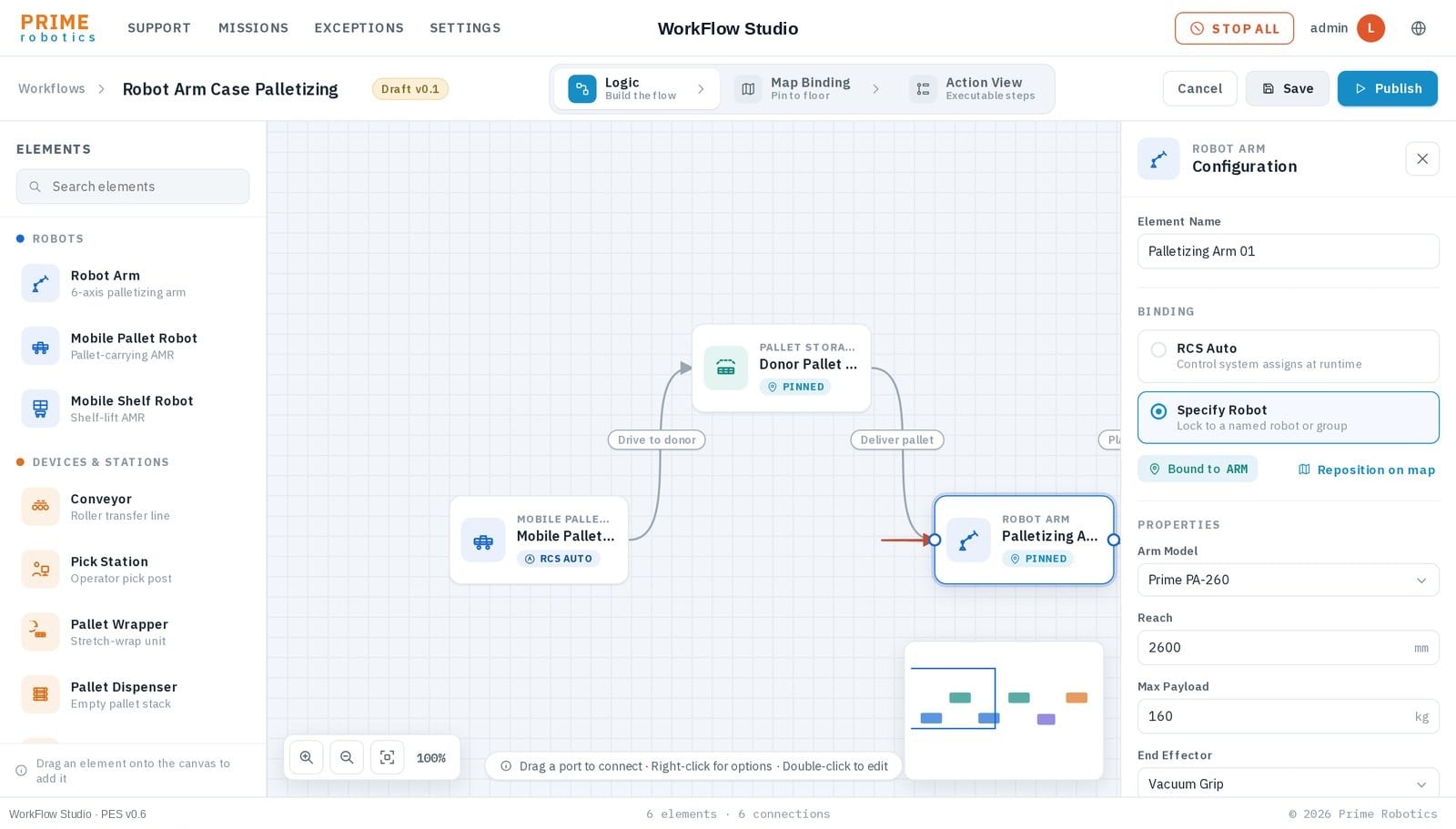
Where engineers define how the floor behaves — and then watch it happen. WorkFlow Builder is drag-and-drop: every robot, station, and wrapped device is an object you compose into triggers, responses, and sequences with no code. Dashboards give live visibility into every workflow on the floor.
Robots, arms, conveyors, wrappers, pick stations — drag any of them from the library onto the canvas.
Connect objects into a live sequence — “drive to donor → deliver pallet” — with triggers and responses.
Publish, and the execution engine runs the workflow across the fleet — load-balanced, in real time.
The clearest example is manufacturing: “when MES signals a kit order, retrieve components A + B + C, assemble at station 4, deliver to line 7.” You define it once here — PES executes it, load-balances it, and holds the JIT timing.
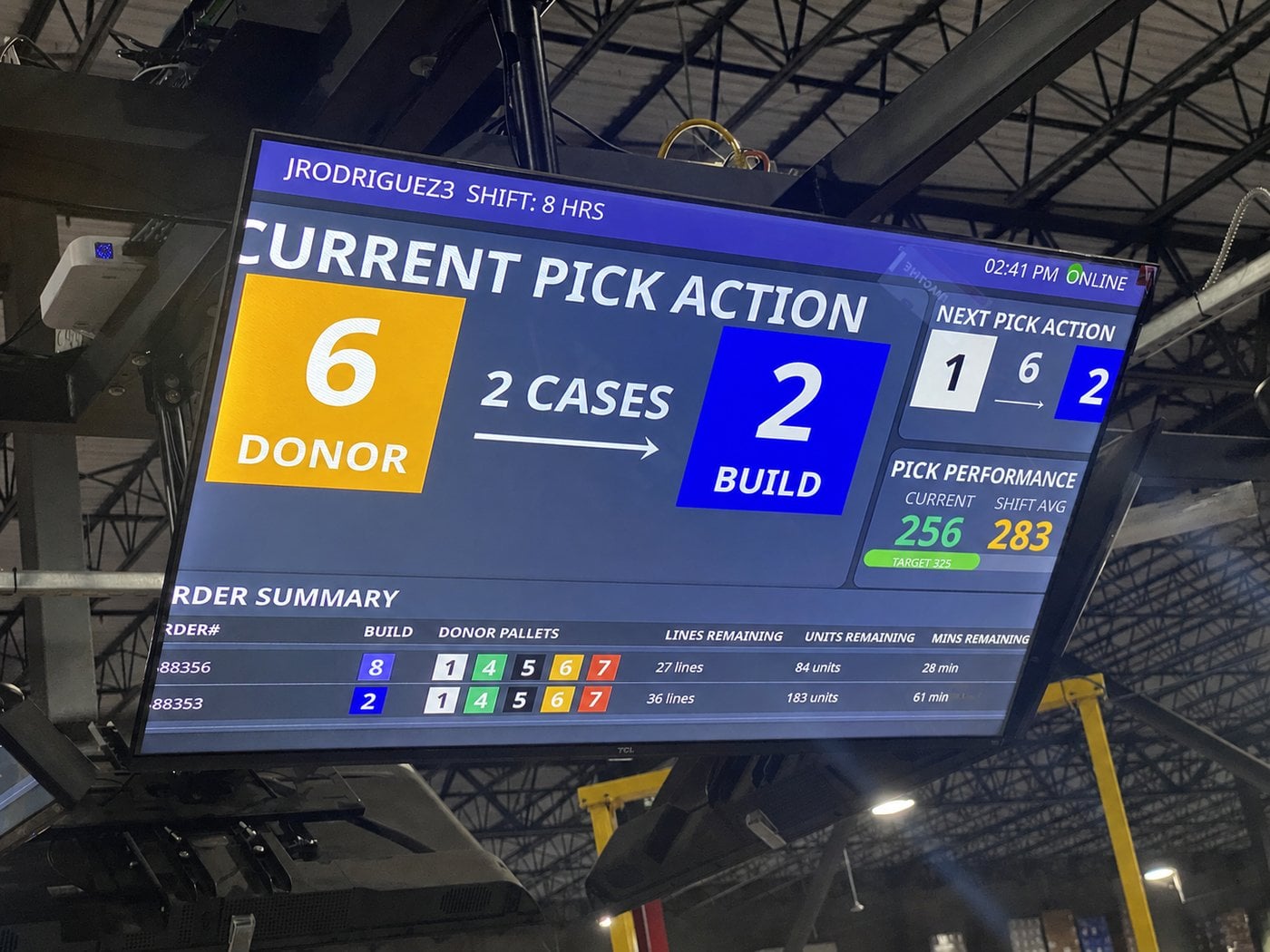
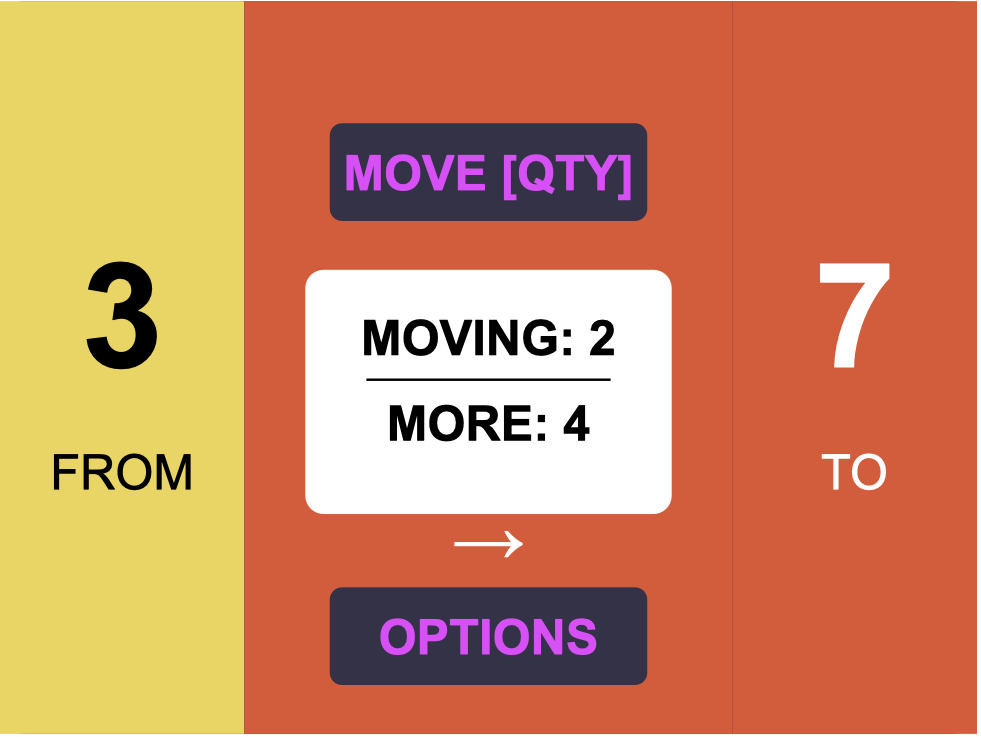
The always-on control application — a digital twin of the operation on the big screen for supervisors, and clear, simple instructions on the small screen for every operator. Site Manager is where PES becomes something a person can see and act on: what’s moving, what’s stuck, what needs a human.
The intelligence layer that keeps the fleet healthy — battery state, mechanical wear, error rates, all watched continuously so a robot gets a work order before it goes down, not after. The data flows straight into PMC, so fleet health sits next to order performance in one view.
Charge scheduling optimized around shift patterns and throughput — the fleet charges when the floor can absorb it, not on a fixed timer.
Error rates, disk status, and MBTF by robot. Telematics flags the robots trending toward failure so maintenance acts before a stoppage.
Utilization, missions per shift, throughput per operator — the data to optimize staffing, justify capacity, and report outcomes up.
Twelve live deployments. Not pilots — production floors running the platform every shift.
Labor ratio achieved on a live palletizing floor
Production deployments across three industries
Units/hour typical station throughput (mix-dependent)
EWM integration running in live production
CEO · Regional Paper & Packaging Distributor
The full picture of what a single platform orchestrates — above, alongside, and below.
Show Prime what’s on your floor. If it has a PLC or API, can orchestrate it.
Bring us your floor — the Prime equipment and the equipment you already own.
We’ll map to your setup and your biggest bottleneck.