
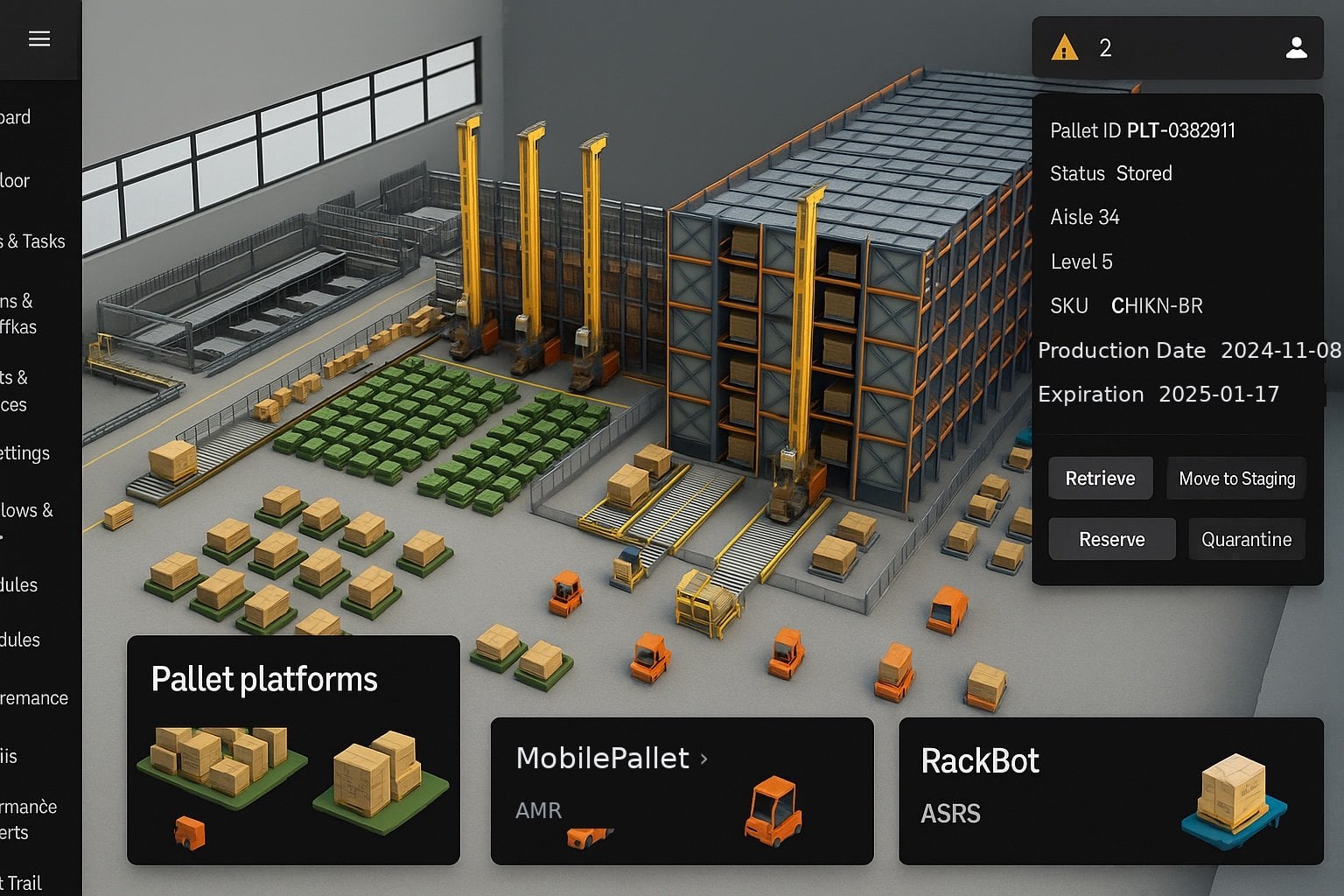
PES doesn’t just move robots — it sees and directs every pallet, rack, and device on your floor in real time. The warehouse execution system built for operations too complex for a WMS add-on. Zero middleware. Native API integration.
System uptime
Software layers
Device types
Middleware required
Native integrations: WMS · ERP · OMS · MES · PLC
Your business systems know what needs to happen. Your robots know how to move. Between them sits the hardest layer in the building — the one that turns an order into coordinated action across dozens of machines. That layer is PES.
Manages inventory, allocates stock, records transactions. It knows what to pick — but it doesn’t drive the floor.
Moves robots from point A to point B. Path planning, traffic control. It moves machines — but it doesn’t execute orders.
Owns the outcome. PES executes orders across every station, robot, and PLC device — and answers for whether the order actually shipped.
Business systems — what needs to happen
Execution — orders become coordinated action
Physical floor — where work gets done
PES is a single platform built from four tightly integrated layers — from the business interface down to the workstation floor.
The same software that lets you build a workflow out of real device objects is the software that runs it live across your floor. Design on the left. Operations on the right. No handoff, no middleware, no second system.
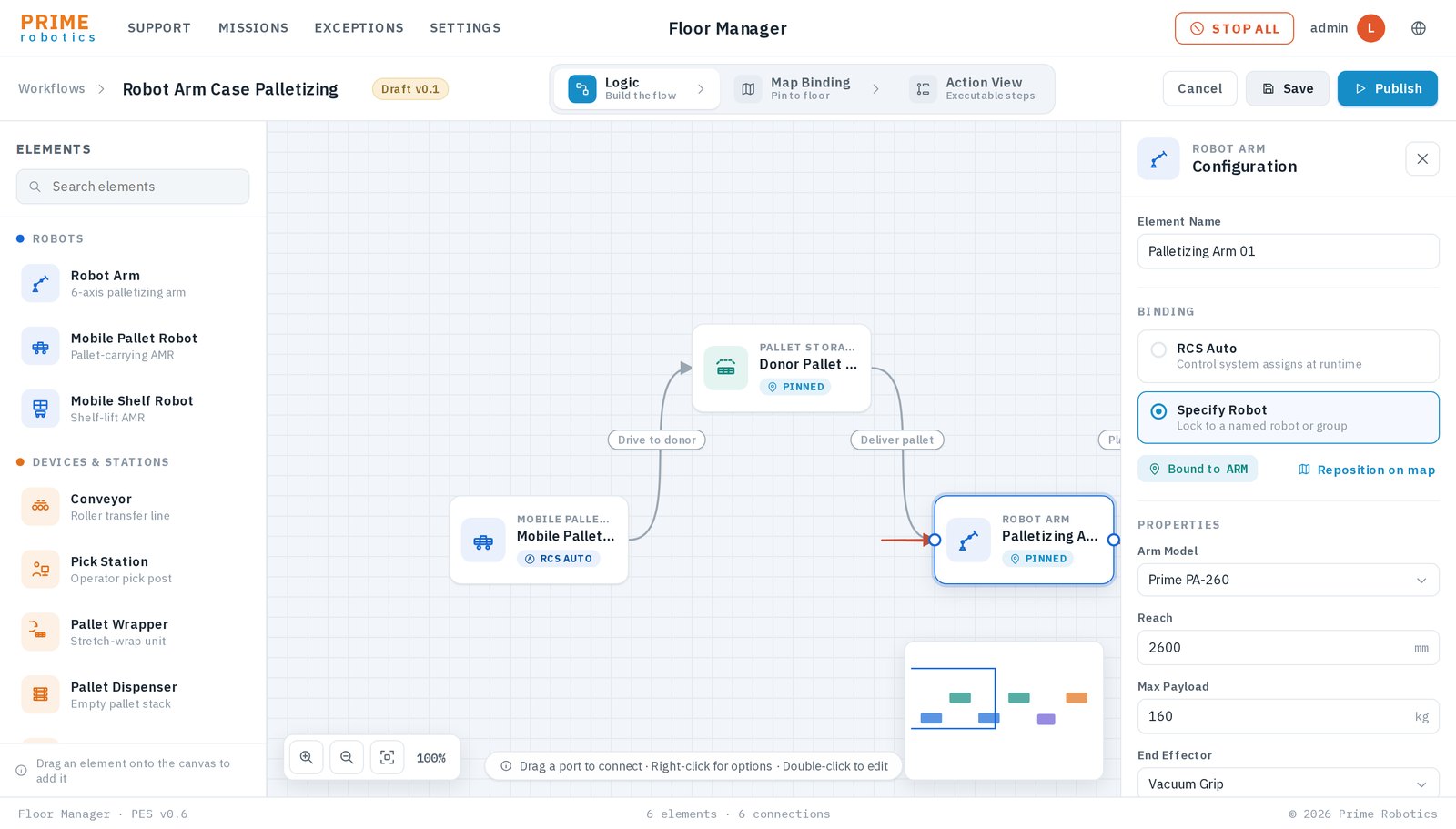
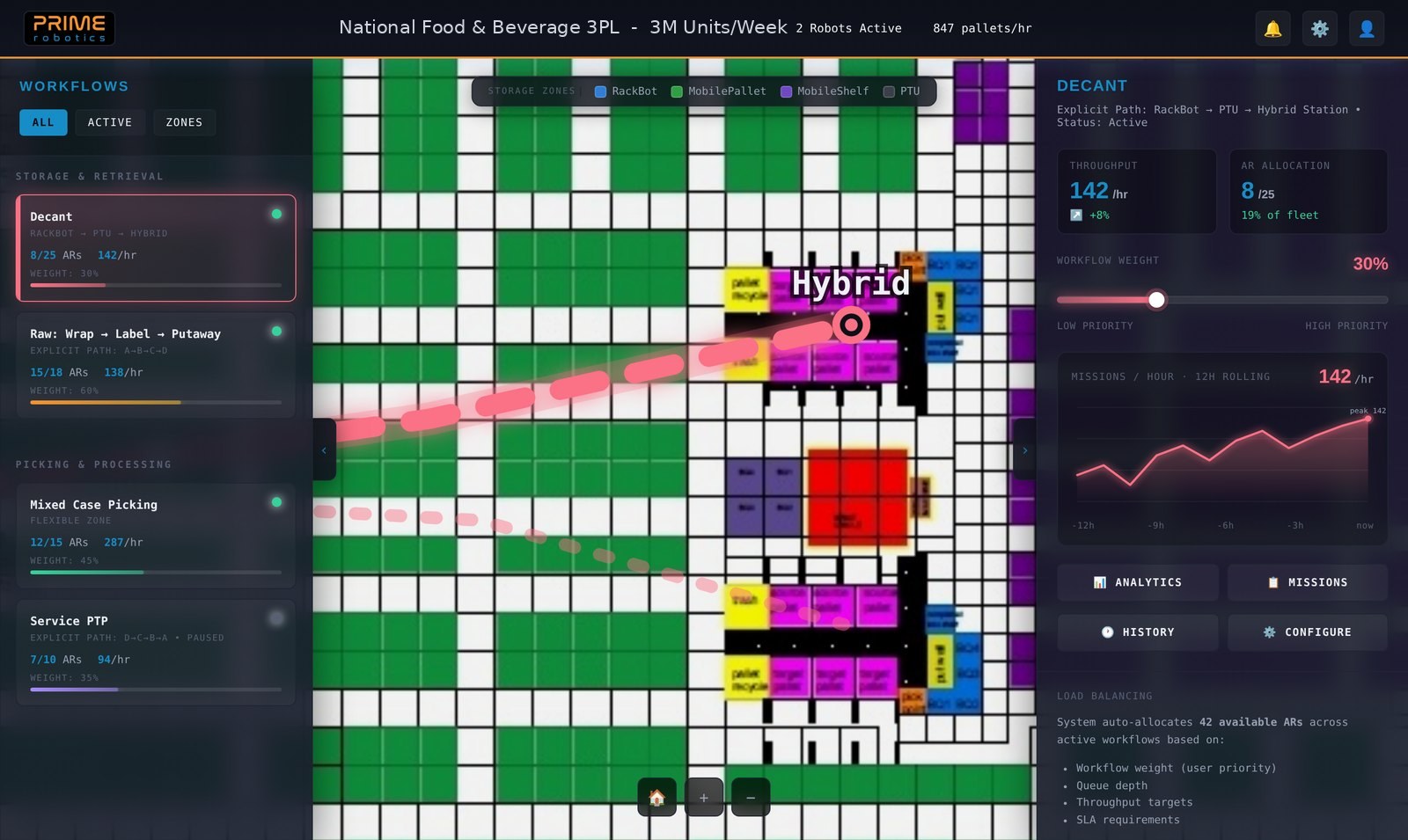
Same product. The workflow you compose on the left is the workflow executing on the right — the Workflow Manager and the live dashboard are two views of one system.
You drag device objects into a workspace, configure how each one behaves and interacts with the others, and pin movement paths directly onto your actual floor map. The result is a deployable workflow — running against real hardware.
Device extensibility: when a new device needs integration, Prime builds an object wrapper around its interface. That object joins the tool chest and is reusable across every future deployment. Integration is done once, never rebuilt.
Reads tomorrow’s actual pick orders — not historical ABC averages — and repositions the highest-demand SKUs closest to the stations before the shift begins.
The robot pool automatically shifts more capacity to dock staging ahead of truck departure, so outbound never waits on a busy floor.
Robots automatically avoid break-room corridors during shift change to keep aisles clear for people, then revert to normal routing afterward.
PES manages every robot as one unified pool and dynamically allocates capacity across concurrent workflows based on schedule and priority.
Competitors manage robots doing one workflow — they can’t load-balance across workflows. This is configurable today, and is becoming AI-driven: at 4PM the system already knows outbound staging needs priority, and shifts the pool automatically.
That live floor view in the hero — every pallet clickable, every robot directable — isn’t a dashboard bolted onto someone else’s hardware. It’s what becomes possible when one company builds the robots and the software together.
Vendor-agnostic platforms sit on top of third-party robots and can only send the generic commands those robots happen to expose. The software and the hardware were never designed for each other — so the floor view is a monitor, not a control surface.
Because we build the robots and the execution software together, PES reaches hardware functions a generic connector can’t — pallet-level state, in-rack sequencing, retrieve and quarantine actions, all directed from one screen. Depth you only get when one team owns both.
Executes orders across every station — not just robot movements. PES answers for the outcome, end to end.
Object-based composition, scheduled workflows, and cross-workflow throttling — all configured, never coded.
Native API integration. No middleware. No custom connectors standing between your systems and the floor.
Directs forklifts and AMRs to replenish stations automatically — before a pick face ever runs dry.
Sequences pallets for dispatch by dock door and departure time, so trucks load in the right order.
Real-time view of the entire operation, proactive issue resolution, and daily reports out of the box.
PES integrates business systems above and every device below — by native API or direct PLC control. No middleware in between.
Prime Execution System
PES doesn’t sit on top of someone else’s robots. Prime engineers the robots and the execution layer to work together — so a sensor built into the hardware becomes a workflow PES can schedule. Here’s what that makes possible, running in production today.
Prime builds weight sensors into MobilePallet. PES schedules a cycle-count workflow for the night, when no picking is happening: robots move through the pallet field, weigh each pallet, and reconcile it against the expected weight for the SKU.
By morning, PES has checked the whole field and flagged only the pallets whose weight doesn’t reconcile — the short list a person actually needs to verify. The count that used to consume a team becomes a handful of exceptions.
It’s a scheduled workflow, like any other in PES: pin it to the calendar once, and it runs every night against the real inventory — no one has to trigger it.
A robot from one company, an orchestration layer from another, an integrator to wire them together. Flexible on paper — but no one owns whether the pieces truly work as one, and the software can only ask the robot to do what its generic interface already exposes.
Prime builds the robots, the stations, and PES to fit each other. A new capability can be engineered into the hardware and used by PES the same day — no generic-API ceiling, no integrator owning the seams. The whole thing is accountable to one team.
Software built to run any vendor’s robot can only speak the generic interface every robot already exposes — and there’s no field there for a measurement a commodity robot was never built to take. Agnostic flexibility has a hard ceiling: it can orchestrate what robots already do, but it can’t give them new senses. Because Prime owns the sensor and the execution layer together, the ceiling is whatever the operation needs — and that depth of integration is what turns into real throughput.
A high-volume food & beverage packaging operation — not a warehouse and not a factory, but both at once — running on a single PES deployment with live ERP integration. PES runs all four of these workflows at the same time:
Collects finished product directly off the production lines as it comes off the floor.
Tracks every lot through a mandated QA hold with time-based release once cleared.
Sequences finished pallets by delivery stop so trucks load in route order.
Builds mixed-SKU pallets at the Advanced Pallet Station from multiple product lines.
Live dashboard figure across deployments
One person now doing what nine did before automation
Native integration only — no custom connectors
CEO, McDonald Paper
Because PES executes the work, it holds the data the work generates — order trends, pick performance, and labor output, live and per-operator. No separate BI integration, no nightly export.
Actual pick rate against PES-estimated target, system-wide.
| Operator | Orders | Order Lines | Items Picked | Time | Pick Rate |
|---|---|---|---|---|---|
| Operator A | 173 | 132,061 | 607,989 | 40h 12m | 151 / hr |
| Operator B | 168 | 128,400 | 591,220 | 39h 50m | 148 / hr |
| Operator C | 159 | 121,775 | 560,140 | 40h 02m | 140 / hr |
A WMS add-on bolts execution onto an inventory system. A robot vendor’s RCS only drives its own robots. PES is the execution layer built for the whole floor.
| Capability | Prime PES | WMS Add-On | Robot Vendor RCS |
|---|---|---|---|
| Order execution across all stations | ✓ Yes | Inventory only | Robot movement only |
| Object-based Workflow Manager (no-code) | ✓ Yes | No | Limited / vendor-defined |
| Cross-workflow robot throttling (unified pool) | ✓ Yes | No | One workflow at a time |
| Scheduled workflows | ✓ Yes | No | No |
| Native WMS / ERP / OMS / MES integration | ✓ Native | Same vendor only | Via middleware |
| PLC-based device integration | ✓ Yes | No | Rarely |
| Multi-robot-type orchestration | ✓ Yes | No | Own robots only |
| Outbound sequencing | ✓ Yes | Partial | No |
| Automatic replenishment | ✓ Yes | Inventory flags only | No |
| Works across warehouse AND factory | ✓ Yes | Warehouse only | Depends |
| Support | ✓ US-based | Varies | Up to 36-hr overseas wait |
These three acronyms get used interchangeably, but they describe different layers of the stack. Here’s where PES sits, in plain terms.
A warehouse execution system is the software that decides and directs what happens on the floor in real time — which robot moves which pallet, which station a unit routes to, how work is sequenced across the whole operation. It sits between the planning layer (the WMS) and the physical devices, turning orders into coordinated action moment to moment. PES is a warehouse execution system built for operations too complex for a WMS add-on to run.
A warehouse management system (WMS) manages inventory and orders — what you have, where it’s recorded, and what needs to ship. It’s a system of record and a planner. A WES executes: it takes those orders and orchestrates the robots, stations, and devices that actually fulfill them, in real time. The WMS decides what and when; the WES decides how the work runs on the floor. PES integrates directly with your WMS, ERP, OMS, or MES over native APIs — no middleware layer in between.
A warehouse control system (WCS) drives individual pieces of fixed equipment — conveyors, sorters, a specific machine — at the device level. A WES works a layer up, coordinating across all of it toward the order: balancing many robots and station types as one system rather than commanding one machine at a time. Because PES was built alongside the robots it runs, it reaches device-level control and system-level orchestration in one platform, instead of stitching a separate WCS underneath.
Usually yes — most operations keep their WMS or ERP as the system of record, and PES executes against it. PES is designed to integrate with the planning systems you already run rather than replace them. For operations without a heavy WMS, PES can carry more of the load directly; the right split depends on your environment, which is the kind of thing a walkthrough sorts out quickly.
Tell us about your operation and we’ll walk you through how PES would orchestrate it — your stations, your robots, your business systems. No middleware, no guesswork.